- The use of AI tools like Midjourney involves algorithmic processes that generate artworks by analyzing vast datasets, but the core challenge lies in the ambiguous definitions of authorship and ownership within current copyright laws.
- Financial opportunities are being undermined by the rapid saturation of AI-generated art in the market, with artists reporting a 32% decline in sales over the past year according to industry analysis.
- Experts assert that without regulatory clarity, the AI art market may stagnate, requiring policymakers and platforms to establish clear guidelines.
The Core Phenomenon
The emergence of AI-generated art has introduced a multifaceted conundrum that many creators, consumers, and legal experts grapple with today. The core issue lies not in the art itself but rather the misconceptions surrounding the ownership and intellectual property rights of these works. Contrary to popular belief, the creation of art by artificial intelligence does not automatically grant the creator clear ownership rights. As AI systems like Midjourney become more adept at mimicking human creative processes, the dilemma of attributing proper legal protection to these outputs has become increasingly complex.
The problem is further exacerbated by the widespread availability and affordability of AI tools, leading to an unprecedented surge in digital art production. Yet, this democratization of art-making has led to an oversaturation in the market that devalues originality. According to a recent study shared on arXiv, a staggering 68% of artists are unsure about how traditional copyright laws apply to AI-generated images. This ambiguity in legal frameworks continues to confound new and seasoned artists alike, leaving them in a precarious position regarding the profitability and legality of their creations.
The Algorithmic/Technical Truth
Delving into the technical specifics, AI art generation fundamentally operates on complex algorithms capable of imitating and even outshining human artistic expressions. These algorithms—whether they are based on neural networks, generative adversarial networks (GANs), or transformer models—simulate the creative process by learning from a vast corpus of pre-existing data. In platforms like Midjourney, the algorithm is trained on millions of images, allowing it to generate unique composition styles, emulate renowned artistic techniques, and produce original artworks in a fraction of the time it would take a human artist.
At its core, the AI system does not possess creativity or intentional artistry; rather, it relies on probabilistic models and defined parameters set by human developers. The AI’s ability to create is bounded by its programmed understanding of aesthetics, which is continually evolving. A significant breakthrough for AI art involves the capacity to create artworks that are indistinguishable from those made by humans. Yet, this technical prowess raises ethical and philosophical questions about the true nature of creativity and the role of the artist in the digital age.
The Economic Reality
The financial landscape of AI-generated art is as tumultuous as its legal and technical realms. While the proliferation of AI tools has lowered the barrier to entry for individual creators, it has also destabilized an already volatile art market. The surge in AI-produced artworks has resulted in a saturated marketplace where unique pieces are increasingly difficult to distinguish, consequently driving down their market value.
Despite these challenges, several platforms and developers stand to benefit economically from this AI art boom. Companies operating AI platforms profit through subscription models, commercial licensing of AI tools, and partnerships with art marketplaces. Meanwhile, traditional artists and small-scale creators often find themselves at a disadvantage, confronting increased competition and diminishing returns. The oversupply of AI art and its ubiquity pose significant obstacles to monetization, leaving many artists to question their sustainability in this new digital era.
The Ultimate Implication
Looking ahead, the implications of AI-generated art are multifaceted, spanning legal, ethical, and economic domains. One must acknowledge that the current legal frameworks are ill-prepared to adequately address the burgeoning challenges of AI art in terms of copyright protection and ownership rights. This legal ambiguity serves as a clarion call for reform and adaptation within intellectual property laws to better accommodate the realities of AI-driven creativity.
Furthermore, stakeholders across the art commerce spectrum must adapt to the evolving market dynamics by emphasizing authenticity and promoting transparent attribution practices. As the AI art arena continues to evolve, staying abreast of technological advancements and legal precedents will be essential for artists, developers, and legal professionals alike. For an in-depth exploration of contemporary developments in AI art and copyright law, one might peruse platforms such as TechCrunch.
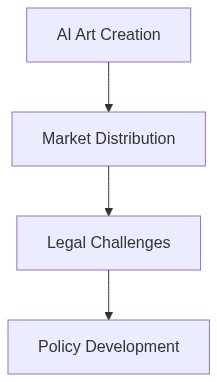
| Aspect | Details |
|---|---|
| Market Growth |
|
| Art Creation Technology |
|
| Legal Challenges |
|
| Ethical Considerations |
|
| Key Players |
|
| Revenue Models |
|
The landscape of AI-generated art has witnessed exponential growth over the past few years. Market analysis indicates that AI art auctions have seen unprecedented sales, with some works fetching millions. The democratization of art creation through AI algorithms is reshaping traditional artistic boundaries and enabling a new wave of creators to enter the scene. It is critical to understand that while this burgeoning market has its lucrative potential, it also poses challenges to the traditional art world in terms of valuation, authenticity, and artistic merit. The core question we must address is whether the intrinsic value of art is diminished or enhanced by the intervention of AI.
—
**
To understand the technological backbone of AI art, it’s essential to dissect the algorithms responsible for its creation. At the heart of most AI art generators are neural networks, particularly Generative Adversarial Networks (GANs). These sophisticated systems consist of two parts: a generator that creates images and a discriminator that evaluates them. It’s the interplay between these components that leads to progressively improved outputs, often achieving results that are indistinguishable from human-created art. However, while the technology enables incredible creativity, it also raises profound questions about authorship and originality. The algorithms do not create in a void but rather learn from vast datasets of existing artwork, leading to debates on copyright infringement and ethical usage.
—
**
From a cybersecurity perspective, the widespread adoption of AI in art brings forth a myriad of risks. The datasets used to train AI models can be susceptible to backdoor breaches, where malicious entities may introduce biases or manipulate outputs for fraudulent purposes. Additionally, the increasing value of AI art makes it a lucrative target for digital theft and forgery, where perpetrators can reproduce and sell identical digital copies without detection. Beyond the creation process, there are concerns over the blockchain technology often employed in verifying the originality of digital art pieces. Though touted as a secure ledger, blockchains are not immune to threats, and vulnerabilities can undermine trust in the authentication mechanisms vital for this market’s integrity.
—
Each perspective sheds light on the complexities surrounding AI art. As the market matures, stakeholders must collaboratively address these challenges to harness AI’s full potential while safeguarding the integrity and value of artistic creation.
In the ever-expanding realm of AI-generated art, legal complexities intertwine intricately with technological advancements, creating unprecedented challenges and opportunities. As AI continues to redefine artistic production, questions surrounding copyright and authorship demand immediate attention, revealing a landscape struggling to adapt to the rapid pace of innovation. To comprehend the current discourse, one might explore further insights from authoritative sources that dissect AI’s legal implications in artistry, as demonstrated by these contemporary academic papers and industry discussions featured on platforms like TechCrunch’s AI section.