
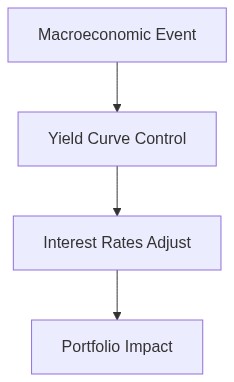
- Yield curve control (YCC) aims to cap government bond yields, potentially leading to market distortions.
- Central banks are simultaneously pursuing quantitative tightening (QT), reducing balance sheets and liquidity.
- The conflict between YCC and QT could lead to unintended consequences in financial markets.
- There is a risk of sovereign debt market dislocations as central banks struggle to manage multiple objectives.
- Investors should be vigilant of central banks’ policy shifts that might trigger sudden spikes in yields.
- The interplay of YCC and QT could challenge central banks’ credibility and effectiveness.
- Historical instances of yield curve control illustrate the potential for asset price bubbles and mispricing.
“Risk cannot be destroyed; it can only be transferred or mispriced.”
The Looming Disaster of Yield Curve Control
The Theoretical Underpinnings and Flaws of Yield Curve Control
Yield Curve Control (YCC) represents a fascinating, albeit contentious, instrument within the central banking toolkit aimed at influencing the term structure of interest rates by pegging medium- to long-term yields at specified levels. As an extension of traditional open market operations, YCC attempts to micromanage the bond market, primarily by committing to purchase sovereign bonds at targeted yields. This control ostensibly suppresses upward pressure on interest rates, facilitating fiscal expansion. However, the theoretical allure of YCC is marred by fundamental inconsistencies. While the primary objective is to anchor yields, YCC contradicts the natural state of free-market price discovery—intruding on the mechanisms that typically assimilate information, calibrate risk premia, and account for terms structure shifts.
Central banks engaging in YCC, like the Bank of Japan and the Reserve Bank of Australia, have fundamentally misunderstood the implications of yield suppression on liquidity and market stability. Introducing yield targets into the market disrupts the so-called ‘natural’ rate where supply and demand for capital balance. Sustained peg interventions require aggressive bond purchases, expanding central bank balance sheets, which exacerbate financial imbalance risks. Moreover, YCC compels investors to reassess bond convexity given its suppression of volatility, potentially precipitating aggressive reallocations into riskier assets as investors search for yield. This breadth of malinvestment cascades into asset bubbles that may unravel uncontrollably once policy normalization begins.
The theoretical assumptions underpinning YCC fail to consider the dynamic response of market participants who, recognizing the artificial constraints on yields, adjust their strategies in obfuscating ways that may not align with policy intentions. More critically, the credibility of a central bank is strained when unforeseen economic variables necessitate deviations from a predetermined yield path, accentuating distortions within forward rate agreements and the broader derivative markets. A scenario wherein the central bank’s commitment is tested and yields rise precipitously could result in a ‘volatility paradox,’ where heightened market perceptions of central bank fallibility catalyze abrupt repositioning, further destabilizing the economic milieu.
Empirical Evidence: Lessons from the Frontlines of Yield Curve Control
Turning to empirical insights, Japan offers a poignant case study on the ramifications of protracted YCC. Since its inception in 2016, the Bank of Japan’s yield target strategy has resulted in a liquidity drain and a perilous spiral of dependency on central bank intervention. “The protracted absorption of sovereign debt by the Bank of Japan has effectively hollowed out the JGB market,” stressed a Bank for International Settlements report, leaving it devoid of retail investors and laying bare the vulnerability to policy shifts. Illiquidity in the bond market creates an echo chamber effect, where reduced participation feeds volatility, inversely mimicking the desired stabilization effects. Investors, in search of premium returns, increasingly pivot towards higher-risk securities, manifesting in burgeoning equity valuations and escalating real estate prices.
Similarly, the Australian experience with YCC has highlighted the fragility of such a policy framework in the face of unanticipated shocks. External pressures, including global inflationary trends and geopolitical disturbances, have roused the Reserve Bank of Australia to contend with significant deviations from their stated yield targets. A Federal Reserve analysis poignantly observes, “The capitulation of the Reserve Bank to abandon its yield peg amidst rising inflationary pressures has undermined its policy credibility.” This abrupt policy pivot unraveled investor confidence, spiraling into abrupt yield spikes that translated into equity and currency market disruptions.
These case studies vividly underscore the pitfalls of yield curve control when markets face regime changes. More insidiously, they reveal an intrinsic linkage between monetary policy and investor behavior under conditions where policy orthodoxy is stretched across the chasms of imperfect information and dynamic shifts in global capital flows. The synchronization of market meltdown risks with centralized economic governance under YCC creates a latent systemic risk, arguably inflamed by moral hazard and speculative zeal fostered under prolonged periods of artificially controlled yields.
The Unintended Consequences: Distortions, Dislocations, and Dissent
In delving into the intricate cascade of consequences that envelop yield curve control, attention must be devoted to the systemic distortions propagated by this policy. The initial allure is overshadowed by the dislocations arising from its prolonged application, crystallizing in the form of distorted risk signals, impaired functionality of the bond markets, and the gradual erosion of fiscal-policy equilibrium. The suppression of yield volatility systematically understates the true economic risks, leading to an anomalous depression of the liquidity premium, which paradoxically induces an overconfidence in market stability and further risk-taking behavior.
Furthermore, the challenge of managing divergent interest rate expectations under YCC manifests in the perpetuation of negative yielding bonds in environments subsumed by low growth and inflation paradigms. The distorted yield landscape gives rise to a duration trap where bondholders, ensnared within low yield environments, are pressured into lengthening maturity profiles to capture incremental yield, thus accruing susceptibility to pronounced convexity-induced losses in rapidly shifting rate regimes. This manipulation of yields undercuts the informational efficiency of financial markets, engendering a myopic dissociation between prevailing economic conditions and resultant pricing structures, analogous to a ship navigating without a compass amid turbulent seas.
Finally, YCC inadvertently magnifies dissent towards monetary policy architectures, particularly from fiscal authorities whose policies must adapt to speculative market dynamics untethered from realistic yield thresholds. This discord becomes manifest in political arenas where economic sovereignty is debated, as fiscal rectitude is compromised by skews in debt servicing costs and public expenditure forecasts detached from historical norms. In wrapping up, YCC, rather than presenting a solution, has inevitably compounded the intricacies of monetary policy implementation, foreshadowing a tumultuous denouement that bears witness to the repercussions of attempting to ordain market realities, an endeavor fraught with peril at the intersection of policy, prediction, and praxis.
| Criteria | Retail Approach | Institutional Overlay |
|---|---|---|
| Strategy Goals | Maximize short-term yields; Preserve capital | Optimize portfolio risk; Enhance long-term returns |
| Market Access | Limited to publicly available markets | Access to a wider range of financial instruments |
| Risk Management | Basic diversification | Advanced hedging techniques and stress testing |
| Tools Used | Online trading platforms; Basic analytical tools | Proprietary algorithms; Specialized software |
| Regulatory Constraints | Subject to retail investor regulations | Complex regulatory environment for institutional investors |
| Transaction Costs | Higher due to smaller transaction sizes | Lower due to economies of scale |
| Investment Horizon | Short to medium-term focus | Long-term strategic outlook |
| Reaction to Yield Curve Control | Limited ability to adjust rapidly | Dynamic adjustments with minimal lag |
| Impact of Yield Curve Control | Potentially significant impact on returns | Structured strategies to mitigate impacts |
Given the current yield curve dynamics and the historical context of a flattening yield curve often preceding recessions, it is prudent for portfolio managers to adopt a cautious stance. This involves reducing exposure to sectors that are highly sensitive to economic cycles such as financials and cyclicals. Instead, focus on increasing allocations to defensive sectors like consumer staples and utilities, which tend to perform better during economic downturns. Additionally, consider increasing cash positions or low-duration bonds to mitigate potential risks associated with interest rate changes and ensure portfolio flexibility to capitalize on future opportunities as the economic environment evolves.”