
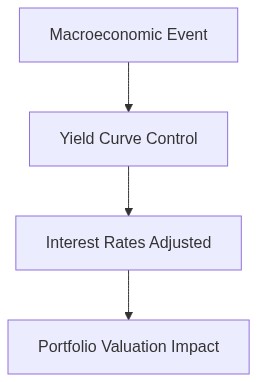
- The surge in interest rates due to Yield Curve Control adjustments raises the cost of refinancing for commercial real estate owners.
- A large volume of CRE debt is set to mature in 2026, creating a refinancing cliff where borrowers struggle to secure favorable terms.
- Regional banks, with significant exposure to CRE loans, face increased default risks, affecting their stability and liquidity.
- Potential for regulatory intervention as YCC policies and regional bank vulnerabilities converge into a systemic financial risk.
- Investment strategies are shifting as institutional funds reevaluate risks associated with regional bank stocks and commercial real estate portfolios.
“Risk cannot be destroyed; it can only be transferred or mispriced.”
The Interest Rate Surge: Catalyzing a Credit Convolution
The commercial real estate (CRE) sector stands at the precipice of a credit landmark fraught with challenges, exacerbated by a confluence of undesirable economic vectors. The Federal Reserve’s policy shift towards aggressive tightening over the past few years has ushered in an era of elevated interest rates, which starkly contrasts with the ultra-loose monetary stance that characterized the preceding decade. The impact of this macroeconomic transformation on CRE refinancing cannot be overstated. The increase in lending rates has precipitated a marked rise in the cost of capital, imposing severe refinancing constraints on property owners who are confronted by a maturity wall of approximately $1.5 trillion in CRE debt over the next three years. This unfolding scenario has triggered concerns over potential default cascades as debt service obligations weigh heavily on cash flows, particularly for assets in sectors such as retail and office that have yet to fully recover from pandemic-induced attrition.
The shifting interest rate environment has amplified concerns about convexity risks inherent in current CRE debt instruments. Property owners who had previously optimized leverage strategies around historically low interest rates are now grappling with the adverse convexity resulting from upward yield shifts. Essentially, as rates rise, the duration and price sensitivity of CRE debt magnify, resulting in an asymmetric increase in liability durations against fixed asset returns. Such mismatches exacerbate the refinancing conundrum by inflating coupon rates for refinancing agreements and by dwindling the pool of willing lenders. This interest rate shock has a profound impact on capitalization rates as well, compressing net operating incomes and eroding loan-to-value ratios, which fundamentally alters the risk profiles that dictate investor appetite in secondary markets.
Moreover, the upward revision of rates has introduced a heightened liquidity premium into the CRE asset price models, further exacerbating refinancing woes. The liquidity premium – an additional yield demanded by investors for financing less liquid assets – has grown as monetary contraction drains liquidity from the overall financial system, hypothesizing a heretofore-unanticipated disparity between buyer and seller expectations in property transactions. The bifurcation in liquidity scenarios, paired with the flight-to-quality phenomenon steering capital towards safer, higher-yielding government securities, presents a formidable hurdle for the CRE refinancing landscape, effectively isolating less liquid asset classes in a refinancing quagmire.
Regulatory and Institutional Dispositions: Navigating a Treacherous Terrain
Within the fraught environment of impending debt maturities, regulatory frameworks are pivotal. The U.S. financial regulatory apparatus, subject to its idiosyncratic jurisdictional constructs, has signaled potential recalibrations aimed at fortifying institutional resilience amidst this refinancing imbroglio. The Federal Reserve, by possibly leveraging macroprudential tools, could exert significant influence over capital adequacy requirements for institutions heavily exposed to CRE delinquencies. There is burgeoning discourse suggesting that regulatory bodies might deploy targeted interventions to cushion systemic pressures.
The Federal Reserve has observed, “The rise in market yields may expose vulnerabilities in the real estate sector, necessitating appropriate capital buffers.” Such guidance underscores the need for dynamic risk recalibration within underwriting processes, a daunting task given the prevailing economic volatility and unpredictable forward guidance on monetary policy trajectories.
Compounding regulatory complexities is the role of global financial institutions and their operational mandates towards options to mitigate the ramifications of an ailing U.S. CRE sector. The Basel Committee’s ongoing revisions to international banking standards have placed an added emphasis on counterparty credit risk assessments, compelling institutions to fortify their analytical frameworks to distinguish between heterogeneous asset recovery potentials. These regulatory pressures indirectly engender a differential impact across CRE segments; while institutional-grade real estate may attract stability-oriented capital given its underpinning robust credit architecture, emerging CRE sectors reliant on mezzanine financing structures face amplified capital acquisition barriers.
A poignant concern remains the cross-border implications of refinancing defaults, as transnational banks bear substantial CRE exposures in diversified asset portfolios. As the Bank for International Settlements has highlighted, “The interconnectedness of global finance necessitates rigorous stress testing to preclude contagion from region-specific shocks.” In light of potential systemic risks, elite fund managers are called upon to strategize risk diversifications pragmatically. A proactive multipronged approach that includes stress scenario simulations and dynamic portfolio rebalancing becomes paramount, ensuring inherent systemic shock absorptions are well-positioned to withstand the cascading effects of potential CRE market destabilizations.
Sectoral Divides: Uneven Resilience and Recovery Trajectories
The impending CRE refinancing crisis is dissected effectively through a sectoral analysis, which reveals an uneven terrain of resilience and recovery. The bifurcation within the real estate segments – office, retail, industrial, and multifamily – is stark, driven predominantly by secular trends post-2020 that have not only shaped tenant occupancy dynamics but have also redefined asset value perceptions. In particular, the office space segment grapples with prolonged repercussions of remote work policies, leading to diminished valuation trajectories and, consequently, exacerbating refinancing adversities. Despite incremental concessions on lease structures to attract tenants, the upward pressure on capitalization rates remains insufficient to absorb the pervasive vacancy risks that plague this segment.
Retail properties are encountering a similar desultory outlook as shifts in consumer behavior have pivoted extensively towards e-commerce, actively displacing foot traffic in traditional shopping conduits. The resulting contraction in rental income streams subjects retail property owners to deflated net present value calculations, consequently straining refinancing compacts and curtailing capital infusion prospects. Conversely, the industrial and logistics dwellings display commendable resilience backed by unprecedented demand surge due to reshoring initiatives that have catalyzed warehousing and distribution expansions. However, while the sector ostensibly thrives, elevated interest expenses serve as a marginal detriment that cannot be overlooked when considering long-term yield optimization metrics.
Multifamily housing reflects a heterogeneous set of challenges, therein lies the diversification of refinancing risks between Class A properties, often backed by institutional warranties, and mid-tier segments struggling under affordability crises impacting rental yield prospects. Thus, an imperative exists to delineate risk stratifications within the refinancing scope. Elite fund managers would benefit from adopting a sector-specific lens to gauge refinancing potentials effectively and enact strategic capital allocation adjustments tailored to navigate each segment’s idiosyncratic hurdles and potential inflection points. Such discriminant strategy formulation should inherently account for momentary macroeconomic data fluctuations and emerging regulatory dictates to enhance risk-adjusted return profiles across CRE portfolios.
| Criteria | Retail Approach | Institutional Overlay |
|---|---|---|
| Investment Horizon | Short to Medium-term | Long-term |
| Risk Tolerance | Moderate to High | Low to Moderate |
| Capital Deployment | Lower Capital Requirements | Significant Capital Commitments |
| Flexibility | High Flexibility in Exit Strategies | Structured and Rigorous Approach |
| Due Diligence | Simplified Due Diligence | Extensive Due Diligence Processes |
| Portfolio Diversification | Niche Focus, Limited Diversification | Broad Asset Classes |
| Impact of Market Volatility | Higher Sensitivity | Lower Sensitivity |
| Execution Speed | Faster Execution | Slower, Methodical Execution |
| Access to Debt Markets | Limited Access | Preferential Access |
| Risk Management Tools | Basic Risk Mitigation Strategies | Advanced Risk Management Techniques |