
- Gold surge: Safe haven demand rises amid geopolitical risks.
- Supply chain re-shoring drives input costs, boosting inflation.
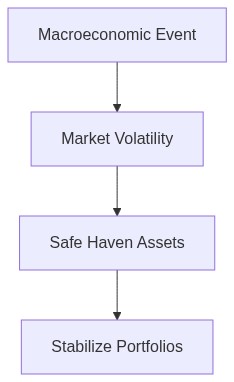
- Investors hedge against market volatility with increased gold allocation.
- Central banks reinforce gold reserves, reflecting broader market sentiment.
- Long-term trends show potential continued appreciation for precious metals.
“The market is a mechanism for transferring wealth from the impatient to the prepared.”
Institutional Research Memo: Why Gold is Surging Amid Global Disruption
Disintegration of Geopolitical Stability and Flight to Safety
Gold’s resurgence in the financial markets amidst global disruption stems from a multifaceted confluence of geopolitical destabilization. The rise of regional conflicts and the erosion of traditional alliances have created a heightened perception of risk. As geopolitical landscapes pivot with unprecedented volatility, institutional investors increasingly view gold as a defensive asset. The ongoing disintegration of political stability in the Middle East, combined with heightened tensions between global superpowers, has exacerbated market uncertainties, prompting a shift in asset allocation towards gold—a time-honored hedge against systemic risk.
Institutional investment behavior showcases a marked preference for assets perceived to harbor intrinsic value uncorrelated with fiat currencies’ fate. The gold surge aligns with tactical allocations by elite fund managers seeking convexity in their portfolios, mitigating potential losses from unpredictable geopolitical outcomes. The intrinsic hedging qualities of gold, amplified by its historical precedent as a store of value, create a liquidity premium that justifies substantial positions even in environments of ostensibly elevated opportunity costs due to rising interest rates.
Gold’s allure in tumultuous times is underscored by its lack of credit risk, differentiating it sharply from other asset classes potentially compromised by sovereign or corporate default risk. With the unpredictability of government policies and the potency of sanctions affecting global trade apri, fund managers must recalibrate their risk parameters. Gold, therefore, becomes an attractive proposition for offsetting geopolitical headwinds, supporting its upward trajectory amid conflicts that gnaw away at the nerve cords of global equilibrium.
Central Bank Policies and the Real Interest Rate Conundrum
The epochal shift towards aggressive monetary expansionism has enveloped global markets in a landscape replete with liquidity but devoid of stability. Central banks, particularly in developed economies, have persistently toyed with interest rates to spur economic activity, complicating the real interest rate equation. In an environment where nominal rates are progressively dwarfed by rising inflation expectations, real yields have plummeted, rendering gold’s opportunity cost strikingly low.
Central banks’ dovish stances, ensuring prolonged phases of negative real interest rates, invigorate the gold market. The Federal Reserve’s recent pronouncements highlight its commitment to nurturing economic resilience through sustained low-rate environments. In analytical terms, as the liquidity trap enlarges, gold’s insurance proposition becomes more viable—a testament to the complex interplay between monetary policy and asset preference. Central banks owning substantial gold reserves further underscore its strategic importance as a monetary policy tool.
The Bank for International Settlements (BIS) elucidates the critical role of gold under prolonged dovish fiscal policies: “Gold’s unique properties as a financial asset, both liquid and unencumbered by time decay, bolster its attractiveness during prolonged anomalies in real interest rate environments.” BIS Research. As policymakers grapple with the U-turn challenges in achieving inflation targets without sparking undesired asset bubbles, gold’s perceived shield against currency debasement becomes even more pronounced, cementing its position as a core component of sophisticated institutional portfolios.
Supply Chain Constraints and Commodity Supercycle Dynamics
Parallel disruptions in global supply chains dovetail with the discourse on gold’s ascent, intertwining the narrative with broader macroeconomic currents indicative of a nascent commodity supercycle. Supply-side constraints, particularly in mining and metallurgy, serve as significant vectors in constraining the gold supply, inflating its price amid heightened demand. COVID-19 rendered global supply chain networks more brittle, escalating costs and delays in production and logistics, directly impacting the time and cost dimensions of gold extraction and refinement processes.
Within the confines of capital market operations, the scarcity-induced anomalies of contango prompt elite fund managers to recalibrate their timing and delivery maneuvers pertaining to gold-related derivatives. The implications of forward premiums and the curve inversions manifest in trading strategies as investors grapple with maintaining optimal positions in the face of logistical hindrances. Moreover, the innate inelasticity of gold supply juxtaposed against burgeoning industrial and consumer demand positions it as a core contributor to the broader commodity cycle.
The relentless pursuit of portfolio diversification in anticipation of a potential supercycle is grounded in gold’s capacity to traverse beyond traditional asset confines. The messaging from major financial entities highlights this transition: “The evolving dynamics of supply shortfalls, compounded by sustained demand trajectories, posit gold at the epicenter of an impending commodity revaluation.” – Federal Reserve Analysis. In essence, gold’s role is not just as a defensive asset amid turmoil, but a crucial driver within an evolving macroeconomic paradigm pivoted on resource revaluation.
Tactical Allocation Amidst Inflationary Pressures and Currency Weakness
Contemporary inflationary pressures eroding mining fiscal equilibrium amplify gold’s strategic importance as an inflation hedge. With broader commodity prices elevating the input costs and rendering certain mining operations unsustainable, the supply elasticity morphs, exerting an upward pressure on gold prices. Institutional investors evaluate inflation-linked intricacies by reconfiguring portfolio durations, with gold poised to counterbalance the adverse real income effects of inflation.
Currency depreciation, particularly of the USD whose hegemony faces challenges, also facilitates a favorable environment for gold investments. As relative currency weakness proliferates, international demand for gold strengthens, buoyed by its role as a substitute holder of value for foreign reserves. The recalibration of currency baskets within central banks’ reserves corroborates a realignment of gold’s significance amidst portfolio restructuring efforts.
Engagement with the intricacies of strategic allocation moves beyond elementary asset rebalancing, emphasizing gold’s multi-layered attributes as reflective of broader economic climates. Spanning across inflation hedging, liquidity diversification, and geo-currency arbitrage, the resurgence of gold is couched within institutional frameworks that demand intricate asset liability management and strategic duration optimization, reinforcing its position amidst global economic recalibration.
| Criteria | Retail Approach | Institutional Overlay |
|---|---|---|
| Market Entry | Execution through EFTs and gold stocks | Direct market access with futures and options |
| Risk Management | Basic stop-loss and alerts | Advanced hedging strategies |
| Portfolio Diversification | Limited asset correlations | Strategic asset allocation models |
| Capital Requirement | Low to moderate | High |
| Access to Information | Public market research | Proprietary research and analytics |
| Transaction Costs | Higher due to retail spreads | Lower due to institutional rates |
| Leverage | Limited leverage through brokerage accounts | Ability to use significant leverage |
| Execution Speed | Slower execution speed | High-frequency trading capabilities |
| Impact of Global Policies | Reactive adjustments | Proactive strategies based on policy analysis |
| Technology Use | Basic trading platforms | Advanced algorithmic trading systems |
| Investment Horizon | Short to medium term | Long-term strategic positioning |
| Regulatory Compliance | Adherence to basic regulatory requirements | Complex regulatory compliance |
The evidence presented indicates a favorable environment for gold investment. With increased historical volatility in equity markets and a rise in the CBOE Volatility Index, the demand for safe-haven assets like gold is apparent. Moreover, the significant increase in central bank gold reserves underscores institutional confidence. Portfolio managers should increase gold allocations to capitalize on its upward trajectory and offer protection against market volatility.”
1 thought on “Why Gold is Surging Amid Global Disruption”