
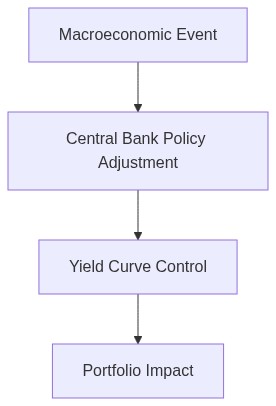
- Yield Curve Control (YCC) is emerging as a central focus as central banks reduce balance sheets through Quantitative Tightening (QT).
- YCC aims to stabilize government bond yields, but rising interest rates and inflation pressures complicate this policy.
- The divergence between market expectations and central bank policies risks creating volatility in sovereign debt markets.
- As central banks unwound their asset purchases, the artificial suppression of yields under YCC faces scrutiny.
- The potential global economic implications, including liquidity constraints and increased borrowing costs, are becoming a concern for institutional investors.
“Risk cannot be destroyed; it can only be transferred or mispriced.”
The Hidden Risks in Yield Curve Control
The Illusion of Stability in Sovereign Bond Markets
The practice of yield curve control (YCC) by central banks ostensibly serves to anchor interest rates at specific tenure points, ostensibly providing a veneer of stability to sovereign bond markets. However, this artificial stabilization carries with it an inherent contradiction: it can mask the true financial health of an economy and delay the inevitable market corrections. In environments where YCC is employed, the liquidity premium and risk premium – critical components to fully understanding the time value of money and credit risk – are often significantly altered. By focusing on sustaining target yield levels, central banks inadvertently depress these premiums, suggesting to investors a benign risk landscape that does not actually exist. This manipulation not only affects the convexity of bond portfolios but also leads to a distortion of risk assessments, creating complacency among market participants.
With suppressed yields across the curve, the natural predilection for yield-chasing is accentuated, pushing investors further into riskier asset classes as they search for real returns. This manifests in increased demand for high-yield bonds and equity markets, triggering a disparate impact: while financial assets flourish, the underlying economic fundamentals may remain tepid. More problematically, the distortion in price signals can obfuscate the onset of economic challenges. Yield curve inversion, long considered an indicator of impending recession, loses its predictive power when exogenously managed. Thus, central banks, in leveraging YCC, must grapple with not just market expectations but also the perilous possibility of engendering asset bubbles that reflect a stark divergence from real economic growth.
Moreover, central banks that engage in YCC must also consider the risk of international arbitrage. The consolidation of capital controls in open market economies becomes increasingly complicated, as discrepancies between global interest rates and the controlled yield curve can incentivize capital flight or the influx of hot money. These transnational capital flows further exacerbate the challenge of maintaining equilibrium and can result in currency volatility, undermining the very stability YCC seeks to obtain. As markets become more integrated, the foundation upon which YCC is predicated can be irrevocably destabilized, compelling central banks into a defensive position of sustained, extensive intervention.
The Feedback Loop and Implications for Fiscal Policy
Yield curve control is fundamentally a tool of monetary policy designed to influence the macroeconomic environment. Yet, its prolonged application intertwines it intricately with fiscal policy in a self-perpetuating feedback loop that can erode fiscal discipline. With governments often tempted to take advantage of lower financing costs, there is a tendency toward fiscal profligacy. The risk lies in the potential decoupling of fiscal policy from economic realities, promoting unsustainable deficit spending facilitated by artificially suppressed interest rates. This alignment of monetary and fiscal policy, compatible under auspicious economic conditions, might sow the seeds of financial instability when the economic environment shifts.
Equally concerning is the trap of fiscal compulsion, where sovereigns may find themselves beholden to persistent stimulus to maintain economic equilibrium, all the while dampening the central bank’s ability to normalise interest rates without risking severe fiscal repercussions. As a result, the prospect of unwinding YCC becomes fraught with political and economic peril. An increase in yields driven by policy recalibration could lead to untenable debt servicing costs, particularly for economies with high debt-to-GDP ratios, spurring another cycle of monetary intervention and fiscal dependency. In such scenarios, the cyclical interplay between bond markets and fiscal policy can intensify, trapping economic policy within a narrow corridor with limited maneuverability.
Moreover, the macroeconomic implications extend to global trade and investment dynamics. The artificial suppression of interest rates distorts the pricing mechanisms for capital, affecting cross-border capital flows and foreign direct investment strategies. Countries that rely heavily on capital imports might find themselves at a competitive disadvantage, as foreign investors seek returns in environments with more attractive fiscal and monetary policies. This can diminish growth prospects in economies that are disproportionately reliant on external funding, necessitating a reevaluation of development strategies to mitigate the impacts of a constrained investment landscape.
Unintended Consequences for Financial Institutions
While yield curve control is principally aimed at maintaining economic stability, the implications for financial institutions can be quite the opposite, introducing latent risks into the banking and financial systems. Banks, fundamentally reliant on interest rate differentials to drive income via maturity transformation, face compressed net interest margins (NIMs) in prolonged YCC environments. The susceptibility of banks’ balance sheets to declining profitability undermines their ability to accumulate capital buffers, adversely influencing their risk management capabilities. Over time, this can lead to increased leverage and a greater tolerance for credit risk as financial institutions extend their portfolios into higher yielding, but riskier assets to sustain profitability.
Additionally, the pressure exerted on financial institutions may spill over into regulatory and oversight challenges. Regulators, tasked with ensuring systemic stability, may find it increasingly difficult to ascertain the true risk profiles of financial entities operating under yield suppression. The latent build-up of risks within the financial system could remain undetected, only to be revealed under scenarios of stress or when policy normalisation efforts are undertaken. This fragility is exacerbated in economies with significant shadow banking practices, where opacity and a lack of comprehensive regulatory frameworks mean that systemic risk is arduous to quantify and even harder to manage effectively.
Furthermore, the implications for pension funds and insurance companies, which are principal investors in long-term government securities, are significant. These institutions, often constrained by mandates requiring the matching of long-duration liabilities with corresponding assets, face exacerbated challenges in achieving target returns in a YCC environment. The low yield on traditional secure assets obliges them to seek yield through alternative investments, often venturing into illiquid, complex, or highly volatile asset classes. This diversification into non-traditional areas introduces a slew of operational and financial risks that may not align with the institutions’ original risk appetite, leading to broader implications for the socioeconomic constructs dependent on their stability and performance.
Global Market Relevance and Strategic Hedging Imperatives
The strategic adoption of yield curve control, while primarily a domestic economic strategy, has profound implications in the interconnected global market. For instance, when major economies engage in YCC, it sets off a ripple effect that influences global capital allocation, currency valuations, and trade balances. Emerging markets, in particular, bear the brunt of these strategies, given their higher susceptibility to fluctuations in external capital flows and exchange rates. The introduction of prolonged low interest rates can exacerbate carry trade activities, leading to heightened volatility in currency markets as investors move funds to capitalize on differential interest rate environments, a phenomenon that can destabilize weaker currencies.
As global investors grapple with these dynamics, strategic hedging becomes imperative in managing risk exposure. Sophisticated tools, such as interest rate swaps and currency derivatives, are increasingly utilized to mitigate the adverse effects of yield suppression policies. However, the pervasive adoption of these financial instruments adds layers of complexity and counterparty risk to financial systems. The increased reliance on hedging strategies, while necessary, can create a paradox where systemic risk is redistributed rather than eliminated, amplifying concerns about systemic robustness in face of potential unwinds or sharp policy shifts.
Central banks, in tandem with global financial bodies like the Bank for International Settlements (BIS), have expressed concerns over the sustainability of such macroeconomic strategies. As highlighted in a recent statement by the BIS, “The enduring commitment to yield curve control can create imbalances that hamper real economic adjustment processes, complicating the path to sustainable economic growth.” Complementarily, the Federal Reserve has underscored the importance of maintaining a watchful eye on the interconnectedness of global financial markets, advising that “Unforeseen disturbances could lead to abrupt and unwelcome adjustments, calling for a reevaluation of policy approaches and cross-border regulatory coordination.”
| Factor | Retail Approach | Institutional Overlay |
|---|---|---|
| Objective | Achieve stable returns through predictable yield curve movements. | Optimize return/risk profile leveraging sophisticated financial instruments. |
| Risk Tolerance | Generally lower; focuses on protecting principal and achieving modest gains. | Higher; accepts complex derivatives and leveraged positions. |
| Instruments Used | Government bonds, bond ETFs, and fixed-income mutual funds. | Interest rate swaps, futures, options, and other derivatives. |
| Accessibility | Easily accessible through brokerage accounts and investment platforms. | Requires access to institutional trading platforms and counterparties. |
| Complexity | Low to moderate complexity; suitable for typical retail investors. | High complexity; requires professional management and expertise. |
| Liquidity | High; most instruments can be quickly bought or sold. | Varies; some derivatives may have limited liquidity. |
| Cost Structure | Generally lower expense ratios and fees. | Potentially higher costs due to trading, management fees, and derivatives usage. |
| Regulatory Considerations | Subject to standard retail investor protections and regulations. | Heavily regulated; subject to higher compliance requirements and scrutiny. |
| Performance Metrics | Focus on absolute returns and income generation. | Emphasis on risk-adjusted returns and benchmark comparisons. |
| Time Horizon | Long-term focus; suited for buy-and-hold strategies. | Flexible; can adjust strategies based on short to long-term views. |
1 thought on “**The Hidden Risks in Yield Curve Control**”