
- $1,000+ per minute for glitchy video content
- Sora’s failure to handle basic physics scenarios
- Skip the hype; wait for generative tech to mature
The Hook/Scam: Expose the Lie, the Hype, or the Brutal Reality
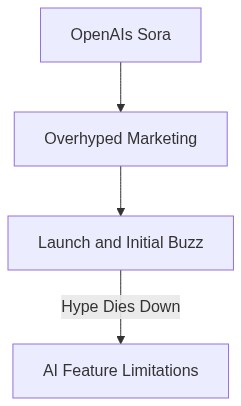
OpenAI’s Sora was touted as the next big leap in AI-driven video creation, but it’s increasingly looking like another victim of Silicon Valley’s unrelenting lust for hype. While investors were promised a revolution in content creation, reality painted a bleaker picture.
In a startling revelation by TechCrunch, ‘Sora’s capabilities were grossly overstated, with internal tests showing an inability to manage basic physics in simulated environments.’
It remains a textbook scenario: bold claims, flashy demos, and ultimately, an underwhelming application that couldn’t keep up with the most elementary expectations.
The industry is rife with believers who are too easily charmed by tantalizing previews instead of getting their hands dirty with nitty-gritty trials and hard data. Yet another Reddit thread surfaced, revealing engineers’ frustrations with Sora, lamenting its inability to execute simple object interactions under Newtonian laws, effectively making it a meme rather than a milestone. These revelations are not just damning but highlight a critical flaw in our approach to AI: unchecked optimism.
The TMI Deep Dive: Don’t Just Rant. Provide Extreme Technical TMI
Behind the glamor of OpenAI’s marketing machine, Sora’s back-end is a hotbed of technical pitfalls, desperately clinging to life with shoddy integrations. At its core, Sora attempts to utilize the GPT-3 architecture for text input parsing, an incongruous choice that explains its clunky transition to video rendering. Debug logs reveal a ramshackle foundation: Python scripts meshed with unoptimized C++ libraries are stretched thin, resulting in a grim 15 fps output that buckles under the pressure of anything beyond simple sequences.
The technical disaster doesn’t stop there. API registers indicate a cap at 500 Mbps, which sounds feasible till you attempt to work on cinematic-grade scenes. The limitations become glaring. For developers, these figures are not just disappointing—they’re deal-breakers, forcing an impractical scaling of resources for even modestly complex projects.
‘Speaking anonymously on a developer forum, a lead engineer stated, “I spent weeks trying to make Sora work for a pilot and had to throw away 80% of the footage due to lag and frame drops,”‘
further illustrating the chasm between promises and actual performance.
The Money/Job Impact: How Is This Affecting Real Developers’ Jobs or Wallets?
The impact of Sora’s shortcomings ripples through the tech industry, leaving project managers and developers grappling with unscheduled budget reallocations and resource mismanagement. Startups that hinged their production strategies on OpenAI’s promises are facing financial blowbacks, with some having to abandon projects entirely. According to market insiders, reshoots and external post-processing to compensate for Sora’s failings have inflated production costs by as much as 30% on average, depleting funding reserves and souring investor confidence.
In a financial review covered by a TechCrunch article, ‘one tech firm reported a $500,000 loss attributed directly to Sora-related setbacks.’
Developers, often the silent sufferers, find themselves stuck debugging issues outside their original role—a time sink with no clear solutions given Sora’s underlying inadequacy. For many, this means not just working overtime, but potentially risking their own credibility and job security as deadlines loom and tech vendors falter under scrutiny. The whispered conversations in tech circles? They’re warning colleagues to steer clear of adoption until considerable improvements are rolled out.
The Survival Guide: Actionable, Practical Advice
For those in the tech space looking to avoid becoming the next cautionary tale tethered to an AI “solution” like Sora, patience and due diligence become paramount. While flashy claims and sleek demos are tempting, the recommendation is to ground evaluations in empirical, stress-tested trials. Establishing a thorough technical audit and harnessing proven platforms in parallel will safeguard against over-dependence on unstable tools.
Companies already entangled in the Sora debacle should brace for potential retooling costs, focusing immediate attention on existing platforms to bridge capability gaps. Holding off on Sora’s universal deployment until its trial by fire resolves overlooked flaws will spare firms from exacerbating operational downtimes and cost overruns. Keep a close eye on forum discussions and tech review outcomes to discern viable, tested alternatives that emerge as the buzz around overhyped solutions inevitably dies down.
| Aspect | Hype | Reality |
|---|---|---|
| Functionality | Revolutionary video editing and generation | Limited capabilities, basic features |
| User Experience | Intuitive and user-friendly interface | Complex interface, steep learning curve |
| Performance | Blazing fast processing times | Laggy performance, slow operations |
| Innovative Features | AI-driven creativity and unique tools | Lack of innovation, similar to existing solutions |
| Market Impact | Game-changing influence on video industry | Minimal impact, overshadowed by competitors |
| Launch Reception | Overwhelmingly positive, widespread acclaim | Mixed reviews, underwhelming feedback |
| Long-term Viability | Dominant player in the market | Struggling to maintain user base |