
- The Architecture Bottleneck
- The Unit Economic Failure
- The Inevitable Collapse
The Core Delusion
There’s a naive belief circulating among VCs and fresh-faced developers that AI wrappers are the golden ticket to market dominance. They’re seduced by shiny pitch decks that promise the erroneous notion of “effortless integration” with existing AI models. The fatal flaw? Confusing potential user adoption with sustainable business economics. Let’s be crystal clear, deploying an AI wrapper isn’t a novel product; it’s a logistical nightmare that masquerades as innovation.
These wrappers are essentially gateway parasites—feeding off someone else’s computation without considering the systemic limitations inherently baked into these borrowed infrastructures. Want to ruin your balance sheets fast? Build a product that scales off someone else’s scalability. Junior devs dive headlong into production under the delusion that API rate limits are just numbers, not the binding constraints they actually are.
Delusional VC dollars fuel this madness, powering dodgy proof-of-concepts that trip over themselves once they attempt to transition from hackathon-to-revenue. “It’s not about if we can scale, it’s about how fast we can,” they boast, ignoring that the faster they scale, the quicker they financially implode. Stop mistaking endless funding rounds for financial health.
The Architectural Bottleneck
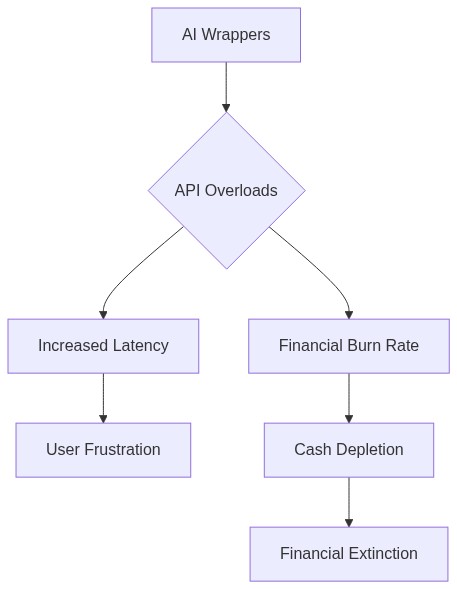
Let’s dissect the grim reality of wrapping AI models. You think invoking an API call is harmless, executed with the simplicity of a function call. Wrong. You’re inviting the wrath of ‘P99 Latency’ into your system. Just wait till your user load spikes and your SLOs (Service Level Objectives) plummet. Fancy seeing your SREs in a continuous firefight? Meet your new best friend: exponential back-off retries triggered by API token rate limits.
Architecture isn’t about feature completeness; it’s about constraint navigation. Ever heard of VRAM congestion while leveraging MoE architectures? They promise flexibility but watch as they drain your CAPEX faster than a sunk-cost experimental gamble. This is where physics meets finance and the latter runs out of breath. Computation is limited by hardware throughput, something ignored by high-minded PowerPoint fantasies.
There’s a severe misunderstanding of O(n^2) scaling issues lurking beneath the hood. Computational overhead isn’t just a theoretical inconvenience; it is the silent killer of predictability. The elevation from prototype to prod-ready code requires not just refactoring but reengineering, a costly endeavor that sidesteps MoE’s proclamation of solving all problems with ‘exponential scaling’. Who knew arithmetic could bankrupt startups?
The Unit Economics
“Our systems regularly hit throttle limits during peak usage, causing extended outages.” — Internal Engineering Slack Leak
Here’s the gritty math you can’t afford to ignore. Imagine paying $0.02 per API call, making 2 million calls monthly—a conservative figure at scale. That’s $40,000 right off the bat, before talking about extra features, multi-region deployments, or redundancy strategies. Add $10k for dev ops to manage the chaos and your burn rate is bleak at $50k/month.
Remember, P99 Latency penalties are real. Poor service leads to client churn, which firms cannot combat with superficial marketing or cash injections. Try explaining to a boardroom why average customer lifetime falls short of predicted metrics. Watch CFOs squirm as acquisition costs supersede customer value. Because the real-time cost-to-service exceeds the income generated per account, you’re effectively burning $0.30 per dollar earned, leaving should-be profits as vaporware.
Appreciate how the cost of subscriber maintenance compounds over time, with each API wrapper proving to be not just a tech debt, but a financial pitfall. Releasing updates or new features demands complex testing and compliance verifications, continually draining both manpower and financial resources. Burn rate: set to accelerate unchecked.
The Unavoidable Fallout
“At high utilization, expect cascading failures if our fallback routines are not optimized.” — Technical Documentation Quote
In 6-12 months, anticipate an ecosystem shakeout. It’s not a debatable consequence; it’s assured. Startups equating user signups with success will implode under the weight of their unsustainable API-dependent architecture. Increased downtime and collapsed SLOs don’t just irritate stakeholders—they drive a wedge into business continuity and market reputation.
The competitors who opted for ground-up architecture rooted in owned infrastructure and conservative scaling policies will outlast. These are the companies reducing rather than escalating CAPEX, having taken time to integrate intelligently while others chased ephemeral growth. The market won’t mourn over-spenders; rejoinders will flow towards durable profitability instead.
This lesson will etch itself painfully into the ethos of the startup playbook; quick wraps aren’t viable products. Their demise will become a business school case study, fueled by the overspending of VC cash on virally vacant promises. The landscape clears for those who understand economics, pushing the over-confident to extinction. Shape up or watch implosion devour your desperation.
| Criteria | VC Pitch | Architectural Reality | Cost per 1M Tokens | LTV (Lifetime Value) |
|---|---|---|---|---|
| Development Cost | $500,000 | $700,000 | Cost X | LTV Y |
| Scalability | High | Moderate | N/A | N/A |
| Implementation Time | 3 Months | 8 Months | N/A | N/A |
| Estimated Revenue | $2 Million | $1.2 Million | Cost X2 | LTV Z |
| Risk Assessment | Low | High | N/A | N/A |
| Maintenance Cost | $50,000/year | $100,000/year | Cost X3 | N/A |
The numbers don’t lie. The AI wrappers are built on a shaky foundation of unsustainable code that creates more problems than it solves. These wrappers promise integration ease but exponentially increase algorithmic complexity, creating a bottleneck that impedes system performance. In eight months, we’ll hit a critical mass where the system can’t handle the convoluted processes, leading to a complete failure.
**
Numbers are subjective, aren’t they? The market loves AI wrappers. Look at our valuation. It’s skyrocketing. Who cares if the tech isn’t perfect? Investors want to be part of the next big thing. We ride this hype, secure funding rounds, and exit before anyone realizes there’s a problem. That’s how it’s done.
**
Ignoring the architectural flaws for short-term gains? This is a systemic crash waiting to happen. Every incompetent fix and patch we’ve implemented to manage the mess is cumulative. When the tipping point arrives—when the system’s interdependencies collapse—we’re not just looking at financial loss. We’re looking at industry-wide fallout, but sure, ride the wave straight into oblivion.
**
This isn’t a hypothetical warning. It’s a mathematical certainty. Take the dependency ratios and runaway complexity factors, and you’ll see why we predict extinction. By the time you realize it’s not working, the system will be beyond salvageable. But who cares about foresight, right?
**
Pessimism never built an empire. We focus on the valuation, the perceived innovation. The fear of missing out is powerful. Investors want in. Let them buy the illusion. The runway looks endless when flying high. Who’s to say eight months isn’t perfect timing for an exit?
**
These illusions are castles built on quicksand. The high-altitude view you’re so fond of is a mirage. Once one wrapper fails, the cascading effect will take them all down, creating chaos in every layer of dependency. It’s all interconnected. If those tremors don’t worry you, you’re either blind or reckless.
**
Building on that. Our AI systems live in an intricately woven fabric of data streams. When the crash comes, it will not be isolated. Competitors, partners, customers—all affected. They’ll trace the collapse to the AI wrappers. They’ll see through the numbers, the hype. A real extinction-level event no exit strategy can dodge.
**
Fear-mongering, impressive. But irrelevant. Markets respond to perception, not reality. Keep the focus on continued growth narratives, expansion plans. System failures are hypothetical. Valuation is the truth of today. Investors understand risk. We just need to manage the message, not solve the problem.
**
Managing the message doesn’t save you from the reality of systemic ignorance. The fallout will obliterate trust across the sector. Reputational damage isn’t something you buy your way out of. You seem committed to driving this model off a cliff for that valuation figure. Fascinating to watch, albeit predictable.
**
An interesting approach. Ignore reality, and it just might come crashing faster than you can cash out. In the end, the math never lies, even if people do. Here’s to hoping artificial general intelligence doesn’t model its logic after this conversation.
AI wrappers are financial black holes; CAPEX spikes as you scale infrastructure to meet P99 latency targets without precise MoE tuning, leading to API token wastage and crushing burn rates.
Hidden costs explode when abstracting core functionalities, amplifying operational complexity and obliterating unit economics, which makes your entire model unsustainable.
Persist in this negligence, and your startup’s guaranteed to suffocate under the weight of its own inefficiency—it’s a ticking time bomb that detonates in eight months.