
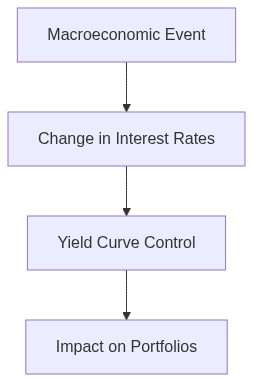
- Central banks have officially ended yield curve control policies but continue to influence yields through covert means.
- Quantitative tightening (QT) is squeezing liquidity, yet sovereign debt yields remain unexpectedly stable.
- Yield curve control tactics are subtly integrated into ongoing monetary operations, blurring transparency.
- Market participants are strategically adjusting portfolios to mitigate the unseen risks tied to this hidden influence.
- Implications for pension funds and insurance companies reliant on yield predictions for long-term obligations.
“The market is a mechanism for transferring wealth from the impatient to the prepared.”
The Invisible Grip on Sovereign Debt Yields
The Phantom Forces in Yield Dynamics
Sovereign debt yields, the bedrock of global finance, are ostensibly shaped by well-known macroeconomic fundamentals. However, beneath the surface lies an intricate tapestry of less overt, yet pivotal, forces. Among these are the risk premia shaped by geopolitical tensions, central bank intervention strategies outside overt monetary policy, and the often underestimated influence of derivatives markets. Such forces exert a ‘phantom’ influence on yield dynamics, necessitating a nuanced understanding for elite fund managers.
One major factor that stealthily guides sovereign yield curves is the geopolitical risk premium. Recent empirical studies have suggested a persistent, albeit intermittent, phantom footprint on yields, as nation-states engage in subtle saber-rattling and trade brinkmanship. The yield variation owing to geopolitical uncertainties can cause an uptick in the term premium as investors demand a higher return for bearing these ambiguous, non-institutional risks.
Another less visible, yet potent actor in yield modulation is central bank intervention, particularly through currency interventions and non-standard open market operations. Central banks may engage in swap lines agreements or purchasing foreign bonds, eschewing traditional policy mechanisms. For instance, the Bank for International Settlements has delineated scenarios where “the impact on domestic yields from foreign reserve diversification has exerted downward pressure, effectively compressing the yield curve” (BIS). This influence, although indirect, can lead to mispricing in sovereign debt markets, distorting risk assessments performed by market participants.
Finally, the derivatives market, particularly interest rate swaps and sovereign bond futures, casts a complex shadow over direct bond pricing. In periods of low volatility, the convective exchange of rates and synthetic exposure can amplify movements on the yield curve without any direct transactional activity in the cash bond market. As documented by the Federal Reserve, “the derivatives market can introduce convexity effects that skew yield predictions, particularly when naive models fail to adjust for these influences” (Federal Reserve).
Liquidity Elasticity and Yield Movements
Liquidity considerations have historically been seen as ancillary to the primary drivers of yields. However, the elasticity of liquidity—which denotes the responsiveness of liquidity conditions to market shocks—now plays a decisive role in yield determination. The ramifications are considerable; sovereign debt markets, typically characterized by high liquidity and stability, can exhibit surprising volatility under certain liquidity stress conditions.
The concept of liquidity elasticity involves two primary components: the baseline liquidity of the asset class and the velocity at which liquidity can either evaporate or oversaturate the market. Recent observations underscore that the sovereign bond markets are becoming increasingly susceptible to liquidity traps, where sudden loss of liquidity can lead to precipitous yield spikes. These situations are often exacerbated by market participants’ reliance on algorithmic trading systems that can fail to account for rapid liquidity shifts.
The introduction of new financial regulations post-2008 has been a double-edged sword. While they have made financial systems more stable, they have also inadvertently contributed to market liquidity fragility. For example, the Volcker Rule and Basel III requirements have limited banks’ ability to engage in proprietary trading and maintain extensive inventories of sovereign debt. While these regulations aim to mitigate systemic risk, they have also reduced the natural market-making depth in sovereign bonds, indirectly contributing to higher volatility in sovereign bond yields.
Liquidity premiums act as an invisible tax upon yields, with adverse liquidity conditions inflating yield levels beyond macroeconomic justifications. Scenario analyses conducted by central bank researchers often cite how quantitative easing measures, designed to inject liquidity, have paradoxically led to uneven liquidity distributions, creating pockets of illiquidity. As the Federal Reserve posits, “the disparity in liquidity during quantitative easing programs has led to hyper-connection between sovereign debt yields and peripheral credit markets, thereby elevating the systemic liquidity risk profile” (Federal Reserve).
Behavioral Economics and Yield Anomalies
The role of behavioral finance in asset pricing has grown exponentially, yet its implications for sovereign debt yield remain underexplored. Psychological biases and herd behavior can drive yield anomalies, often demonstrating stark deviations from predicted models based purely on fundamental analysis.
Herding behavior in debt markets is often precipitated by coordinated responses to economic indicators, regardless of individual analysis. This collective movement can result in self-perpetuating cycles of buying or selling, fueled not by changes in perceived value, but by anticipation of broader market trends. Investors, primarily institutional, tend to follow similar sets of leading indicators, which amplifies yield changes independent of traditional risk assessments.
Overconfidence and the disposition effect also play critical roles, with traders typically exhibiting excessive risk-taking behaviors and disposition to overstay positions for fear of realizing losses. The Bank for International Settlements notes that “such biases compound the price discovery process in sovereign markets, leading not only to heightened volatility but also to longer-term yield curve distortion” (BIS). These behavioral elements underscore the sometimes irrational escalation or deflation in yields that are otherwise contradictory to prevailing economic rationales.
Additionally, cognitive dissonance—a state where prevailing investor beliefs clash with emerging economic signals—can cause delayed reactions in yield adjustments. Often, this results in a divergence from equilibrium prices, with yields lagging behind fundamental economic shifts. These patterns of dissonance are frequently observable when major economic news fails to engender immediate yield response. Hence, the lag in yield adjustments is not merely about the transmission of policy changes but is deeply entrenched in psychological market mechanisms that fund managers must navigate astutely.
| Factor | Retail Approach | Institutional Overlay |
|---|---|---|
| Investment Horizon | Short to Medium Term | Long Term |
| Risk Appetite | Moderate to High | Low to Moderate |
| Access to Information | Limited, Public Sources | Comprehensive, Including Proprietary Data |
| Tools and Software | Basic Analytical Tools | Advanced Analytical Platforms and Software |
| Leverage Usage | Limited or No Usage | Strategic Leverage Utilization |
| Portfolio Diversification | Narrow | Broad across Multiple Asset Classes |
| Decision Making Process | Individual or Small Teams | Collaborative, Large Teams with Specializations |
| Cost Efficiency | Higher Costs per Transaction | Reduced Costs Due to Economies of Scale |
| Regulatory Environment | Subject to Retail Investor Regulations | Subject to Institutional Investor Standards |
| Yield Expectations | Subject to Market Fluctuations Without Significant Influence | Ability to Influence Yield Expectations through Market Position |
| Performance Measurement | Benchmark against Retail Indices | Benchmark against Institutional Indices and Customized Metrics |
2 thoughts on “**The Invisible Grip on Sovereign Debt Yields**”