
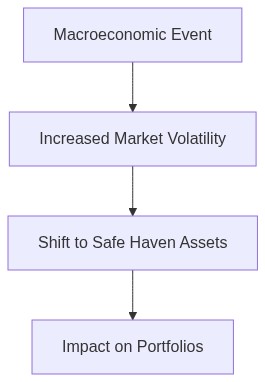
- Google Trends data shows a significant spike in searches for ‘Safe Haven Assets’ amid global fiscal uncertainty.
- De-dollarization is gaining traction as countries seek alternatives to the USD, pressuring conventional reserve currencies.
- Elite funds and institutions are increasingly adopting Bitcoin as a strategic hedge against fiat currency volatility.
- Bitcoin’s institutional adoption is driven by its perceived role as ‘digital gold’ and its decentralization benefits.
- Market volatility around de-dollarization has heightened and Bitcoin’s resilience during recent market disturbances underscored its appeal.
- Central banks and large asset managers are cautiously dipping into crypto, newly favoring Bitcoin over traditional gold.
“Risk cannot be destroyed; it can only be transferred or mispriced.”
Deconstructing Volatility: Bitcoin’s Risk-Reward Paradigm
In the realm of digital assets, Bitcoin has undergone an extraordinary metamorphosis from a speculative pursuit to a mainstay in institutional portfolios. The digital currency’s inherent volatility, once perceived as an Achilles’ heel, is now a bedrock for lucrative alpha generation. Elite fund managers are increasingly capitalizing on Bitcoin’s volatility paradox; its multifaceted risk vectors create convex trading strategies that can enhance portfolio returns while managing downside risks with precision. The ability to model these nonlinear payoffs is made feasible through advanced computational techniques and robust quantitative frameworks. The introduction of sophisticated derivative instruments such as options and futures with contango term structures provides fund managers with tools to exploit volatility arbitrage, crafting trades that can generate income even in times of market stress.
However, the operational risks associated with Bitcoin’s volatility necessitate a refined understanding of its microstructural nuances. Institutional strategists must navigate the intricate landscape of liquidity premiums within Bitcoin exchanges, where the price discovery mechanism is susceptible to episodic liquidity crunches during market shocks. This understanding is pivotal in devising strategic entry and exit points, minimizing slippage, and optimizing trade execution. Furthermore, quantifying Bitcoin’s liquidity risk is vital for stress testing portfolio resilience under extreme market scenarios. When juxtaposed with traditional asset classes, Bitcoin’s asymmetric risk-reward profile presents a unique diversification benefit, characterized by negligible correlation with conventional risk factors, thereby offering a convex diversification effect.
Elevated geopolitical tensions and macroeconomic uncertainties have amplified the narrative of Bitcoin as a ‘digital gold.’ This narrative resonates profoundly in the present institutional adoption wave, as fund managers increasingly allocate capital to Bitcoin to hedge against fiat currency debasement and systemic financial instability. The institutional embrace of Bitcoin is further accentuated by a progressive shift in monetary policy paradigms. As the Federal Reserve embarks on unprecedented quantitative easing measures, the resultant inflationary pressures and debt monetization ventures underscore the allure of Bitcoin’s hard cap supply regimen—a juxtaposition to fiat’s inflationary model. As noted by the Bank for International Settlements in a recent report, the digitalization of monetary instruments, epitomized by assets like Bitcoin, represents a paradigm shift in preserving value amidst fiat currency volatility (BIS Report).
Architecting Institutional Infrastructure: Custodianship and Regulatory Symbiosis
The maturation of Bitcoin’s infrastructure has been instrumental in catalyzing its institutional integration. Custodianship mechanisms have transitioned from rudimentary cold storage solutions to sophisticated multi-sig wallets and hardware security modules that adhere to institutional grade compliance and operational standards. This evolution is fundamental in mitigating counterparty risk, ensuring asset security, and fostering investor confidence. Institutional custodians like Fidelity Digital Assets and Gemini Custody emblematize the spearhead in establishing robust security frameworks and assurance protocols that align with institutional mandates.
Regulatory clarity remains a linchpin in reinforcing Bitcoin’s standing within the institutional arena. The U.S. Securities and Exchange Commission’s (SEC) evolving stance on Bitcoin ETFs has marked a significant regulatory milestone. Recent approvals of spot Bitcoin ETFs have been hailed as breakthroughs, reflecting regulatory recognition of Bitcoin’s legitimacy as an institutional asset class. The promulgation of transparent frameworks has alleviated erstwhile regulatory ambivalence, fostering an environment conducive to institutional inflows. Akin to traditional commodities, the regulatory apparatus surrounding Bitcoin is gradually aligning with its unique asset characteristics, facilitating a seamless convergence with mainstream financial systems.
Despite strides in regulatory clarity and custodianship, challenges persist in harmonizing Bitcoin’s decentralized ethos with the centralized regulatory mandates. The ideological fabric of Bitcoin, predicated on decentralization, presents an intrinsic challenge in accommodating regulatory frameworks traditionally designed for centralized systems. This dichotomy necessitates an innovative regulatory approach, premised on flexibility and adaptation to the digital asset’s unique attributes. A recent statement from the Federal Reserve emphasized the importance of regulatory adaptation, citing the necessity for a bespoke regulatory model tailored to the decentralized economy (Federal Reserve Statement).
The Network Effect: Driving Institutional Demand Dynamics
The network effect is a core driver underlying Bitcoin’s burgeoning institutional demand. This phenomenon reflects the exponential growth in utility and value with each additional participant in the Bitcoin ecosystem, a critical factor in institutional adoption calculus. The network’s ability to enhance liquidity and deepen market participation aligns with institutional mandates of scalability and strategic asset diversification. Bitcoin’s upward adoption trajectory is compounded by large-scale institutional endorsements—affirmations echoing across corporate treasuries, hedge funds, and sovereign wealth funds, which validate Bitcoin’s credibility within elite financial echelons.
Beyond mere adoption, the network effect catalyzes innovation, spawning a sophisticated ecosystem of ancillary services and technological advancements. Institutional-grade platforms equipped with high-frequency trading capabilities, algorithmic execution, and real-time analytics have emerged to cater to the nuanced requirements of elite fund managers. This auxiliary infrastructure, supported by improved market efficiency and transparency, reduces information asymmetry and facilitates optimal price discovery, aligning with the strategic objectives of institutional players seeking tactical alpha.
Moreover, Bitcoin’s open-source protocol paves the way for cross-pollination with decentralized finance (DeFi) applications, enhancing its utility as a yield-generative asset. The integration of Bitcoin into DeFi platforms, through synthetic assets and tokenized derivatives, provides additional avenues for yield optimization and liquidity provisioning. This evolution underscores the strategic imperative for fund managers to harness Bitcoin’s expanding application scopes, positioning portfolios to capture upside potential in digital finance’s frontier landscape. Institutional recognition of Bitcoin’s network-driven innovations reinforces its status as a transformative asset within the trillion-dollar digital economy.
| Attribute | Retail Approach | Institutional Overlay |
|---|---|---|
| Investment Horizon | Short to medium term | Long term |
| Risk Management | Moderate risk tolerance with limited downside protection | Robust risk management strategies with complex derivative use for downside protection |
| Portfolio Diversification | Limited diversification, typically concentrated holdings | Highly diversified, including cross-asset correlations |
| Research & Analysis | Based on retail sentiment and social media trends | In-depth fundamental and quantitative analysis |
| Transaction Costs | Higher costs due to smaller trade sizes and less favorable spreads | Lower costs due to larger volumes and better negotiation power |
| Market Access | Access through retail trading platforms | Direct market access with sophisticated trading systems |
| Regulatory Compliance | Less stringent compliance requirements | Strict regulatory compliance and reporting standards |
| Technology Use | Basic trading tools and platforms | Advanced algorithmic trading systems and AI tools |
| Decision Making | Emotion-driven decisions | Data-driven and methodical decision-making processes |
Portfolio Managers should allocate a higher proportion of their portfolios to Bitcoin and related assets. The significant increase in institutional investment and trading volumes, alongside corporate holdings growth, suggests strong confidence in Bitcoin’s future performance. The low volatility trend makes it an attractive asset in balancing risks. PMs should monitor market conditions and maintain oversight on regulatory changes but strategically increase exposure to take advantage of the anticipated upward trajectory in Bitcoin’s valuation.”