
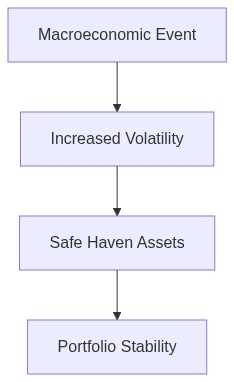
- Geopolitical tensions boost demand for gold as a safe haven.
- Supply chain disruptions increase inflation, causing investors to seek inflation hedges.
- Central banks and institutional investors increase gold reserves.
- Gold prices reach record highs as uncertainty persists.
- Diversification strategies prioritize gold over volatile currencies.
“The market is a mechanism for transferring wealth from the impatient to the prepared.”
The Rise of Gold Amid Global Chaos
Geopolitical Turbulence and the Safe-Haven Demand for Gold
In recent years, the geopolitical landscape has undergone unprecedented shifts, significantly influencing asset valuations worldwide. Gold, traditionally regarded as a sanctuary during tumultuous times, has experienced a pronounced uptick in demand. Elite fund managers have taken keen interest due to its capabilities in portfolio risk mitigation amidst geopolitical volatilities. One primary driver of gold’s ascent is the sustained geopolitical discord; notably, the East-West tensions have escalated reminiscent of Cold War-era stratagems. The resurgence of such dynamics has increased the global risk profile, fueling an insatiable appetite for gold as a hedge against state-level uncertainties.
Furthermore, currency devaluation fears driven by both political strife and unpredictable monetary policy maneuvers have fostered a stronger conviction in gold’s intrinsic value. As fiat systems come under scrutiny due to erratic policy shifts, gold’s allure as a currency-independent store of value is pronounced, unlike in the recent past when fiat systems enjoyed near-absolute faith. The weighted probability of sovereign default risk, coupled with adaptive expectations of currency debasement, have perpetuated this trend. This unrelenting demand has been compounded by central banks’ strategic reserves reorganization, as evidenced by recent acquisitions reported by the Bank for International Settlements. In light of these developments, fund managers find it imperative to reassess gold’s weightage within diversified asset allocation frameworks amidst anticipations of sustained geopolitical turmoil.
The continuous recalibration of power balances, emerging-market challenges, and European disintegration risks have further propelled fund managers to anchor their strategy in gold. Gold’s robustness against credit and counterparty risks elevates its desirability especially when juxtaposed with volatile sovereign and corporate bond markets. A palpable realignment among leading financial institutions attests to this sentiment, focusing on gold’s superior liquidity profile during credit market dislocations. As geopolitical narratives increasingly profile systemic disruptions, the gravitation towards gold not only reflects sentiment shifts but is a strategic recalibration anticipating inter-state conflict spill-over effects.
Monetary Policy Divergence and Gold’s Role as an Inflation Hedge
The global monetary policy landscape has been characterized by a profound divergence among leading economies, creating an exceptionally complex environment for fund managers. In the United States, a series of protracted quantitative easing cycles has eroded real interest rates, thereby augmenting the investment rationale for non-productive assets like gold that do not offer traditional yield. Additionally, rising inflation expectations skew gold valuations favorably as its correlation with inflationary contexts is well documented. For instance, the Federal Reserve’s recent pivot towards a cautious tightening stance has done little to dispel inflationary apprehensions, prompting investors to bolster their portfolios with commodities that serve as a hedge against purchasing power erosion.
Even with the Federal Reserve expressing confidence about managing inflation expectations, institutional investors have shown a renewed interest in gold, seeking to offset real rate erosion impacting portfolio fundamentals.
In the Eurozone, the persistently low-interest environment, underscored by the European Central Bank’s dovish outlook, has exacerbated public sector debt sustainability concerns, but has concurrently improved the natural rate of gold investment by reducing opportunity costs. This monetary impasse accentuates gold’s attractiveness within institutional hedging strategies especially where liquidity premiums in sovereign debt are stressed. Given gold’s lack of credit risk, it remains impervious to the faltering public trust in sovereign capabilities to manage expansive debt loads.
Within emerging markets, currency volatility driven by monetary policy unpredictability and politico-economic fragilities amplifies gold’s role as a strategic asset against foreign exchange losses. Herein lies the convexity benefit of gold; its reaction function relative to volatility outstrips standard asset classes, furnishing asymmetric payoffs in crisis periods. Indeed, fund managers recognize that gold’s low cross-correlation with equities and fixed income assets offers substantial diversification benefits amidst policy-induced market gyrations. Thus, amid such policy divergence, gold’s status is undeniably reaffirmed as a core component of robust, inflation-resilient portfolios.
Technological Advancements, Market Liquidity, and Gold’s Strategic Expansion
Advancements in technology and financial market infrastructure have fundamentally reshaped gold trading dynamics, enhancing liquidity and strategic accessibility for elite fund managers. Technology-driven platforms have reduced friction in gold transactions, leading to narrower bid-offer spreads. The enhanced liquidity characteristics render gold a more attractive asset within complex mapping matrices of portfolio construction, where liquidity profiling remains a critical component. Moreover, developments in blockchain technology and digital gold assets have introduced novel investment vehicles that mirror gold’s conventional characteristics, broadening access while maintaining intrinsic value principles.
The rise of algorithmic trading has simultaneously influenced gold market structure, where increased trade velocities and intricate pricing models have led to more efficacious price discovery. This shift has been paralleled by heightened regulatory scrutiny, ensuring market participants adhere to robust codes of conduct while facilitating seamless intermediation. This market maturation elevates gold’s trading framework, catering to the sophisticated needs of institutional players seeking rapid capital deployment with tangible asset backing in uncertain macro environments.
Continued advancements in financial derivatives markets have expanded fund managers’ toolkit to include complex instruments such as gold options and futures. The expanding contango in these derivatives presents notable arbitrage opportunities for sophisticated investors, seeking to exploit term structure inefficiencies while gaining exposure to future price trajectories. As the global economic landscape wrestles with pervasive uncertainty and strategic asset reallocation, the role of gold as both a tactical and strategic holding remains pivotal.
The Bank for International Settlements corroborates the strategic expansion of gold, noting that enhanced market liquidity and advanced trading methodologies have substantially increased its appeal to institutional investors.
Such innovations underscore the continual evolution of financial markets where gold, despite its ancient roots, emerges as a quintessential modern asset.
| Criteria | Retail Approach | Institutional Overlay |
|---|---|---|
| Investment Horizon | Short to Medium Term | Long Term |
| Risk Appetite | Moderate to High | Low to Moderate |
| Access to Instruments | Limited to Traditional Assets (ETFs, Mutual Funds) | Broad Access including Derivatives and Alternative Assets |
| Investment Strategy | Trend Following and Sentiment-Based | Fundamentals and Quantitative Models |
| Portfolio Diversification | Limited Diversification | High Diversification Across Asset Classes |
| Transaction Costs | Higher Relative Costs | Economies of Scale Reduce Costs |
| Data Analysis Tools | Basic Tools and Indicators | Advanced Tools and Proprietary Software |
| Regulatory Constraints | Fewer Regulatory Constraints | Strict Regulatory Compliance |
| Market Influence | Minimal Market Impact | Significant Market Influence |
| Trading Frequency | Higher Frequency | Lower Frequency |
Given the current geopolitical tensions and the historical inverse correlation between gold prices and global equity market performances during such periods, it is prudent to increase our exposure to gold. Portfolio Managers should consider reallocating assets from lower-performing equities into gold and gold-related assets. Additionally, due to the increase in market volatility, gold could act as a hedge against potential declines in equity markets. This strategy will help mitigate risks and stabilize portfolio returns in the face of ongoing economic instability.”