
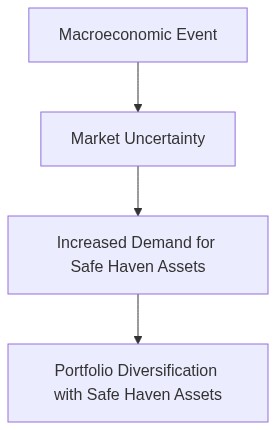
- Geopolitical fragmentation is intensifying, leading to increased demand for safe haven assets like gold.
- Supply chain re-shoring efforts contribute to inflationary pressures, driving gold prices upwards.
- Investors are reallocating portfolios to include a higher percentage of gold as a hedge against global instability.
- Central banks are bolstering their gold reserves in response to economic uncertainties.
- Gold mining and production face challenges, potentially constraining supply and further increasing prices.
“Risk cannot be destroyed; it can only be transferred or mispriced.”
The Complex Dynamics of Geostrategic Supply Constraints
Within the current geopolitical landscape, gold has emerged as an unexpected protagonist amidst a backdrop of severe supply chain disruptions. As nations grapple with a resurgence of protectionist trade policies, the resultant friction has caused a significant bottleneck in the transportation and production of precious metals. Due to these conditions, the convexity inherent in gold’s price response is displaying unanticipated behavior. Ordinarily, price adjustments for gold reflect established patterns of economic recession anticipation or inflation hedging. However, the present circumstances, marked by direct interventions, such as the national stockpiling of resources and export restrictions primarily from major gold producing regions, have triggered pronounced shifts in the liquidity dynamics occupying the gold markets.
This unexpected bottleneck, spurred by geopolitical tensions, has created a supply dearth that has elevated the liquidity premium attached to gold holdings. Speculative activity has been invigorated as futures markets experience contango—indicating an unusual inversion of the expected forward curve—predominantly due to the difficulty in rolling over contracts amidst limited physical delivery capabilities. Additionally, nations in Africa and South America, historically crucial nodes in gold mining, have found themselves at the heart of these supply dynamisms. Their domestic policies have increasingly leaned towards restrictive trade as a defensive tactic against international pressures. Subsequently, investor sentiment reflects a heightened state of anticipatory pricing, not solely resting on demand forecasts, but also steeply contingent upon projected timing of abatement in these geopolitical tensions.
According to recent analyses by the Bank for International Settlements, “the heightened supply constraints in vital resource-producing regions have accentuated the risk premiums associated with commodities, gold chief among them.” This statement underscores the transformation of gold into a barometer, not merely for inflation or monetary policy expectations, but as a complex derivative of cross-border disruptions. Indeed, as financial risk matrices recalibrate, fund managers must now reconcile an uneven landscape where historical asset patterns provide an increasingly unreliable blueprint.
Monetary Policy and the Recalibrated Gold Liquidity Paradigm
The present gold market situation is inextricably tied to the enduring ripple effects of central bank policies enacted over the past half-decade. The Federal Reserve, amidst an environment characterized by cautious economic rebound and inflationary concerns, has maintained an ambivalent stance that leaves investors questioning both the timing and magnitude of future interest rate maneuvers. As recently observed within the Federal Reserve’s policy notes, “the intersection of monetary policy uncertainty and commodity supply logistics complicates traditional valuation matrices” (Federal Reserve Board), evidencing the layered intricacies faced by institutional fund managers.
Aside from the Fed, central banks globally are caught within the crosscurrents of economic pressures and political exigencies. The resultant monetary environments have heralded a re-assessment of the liquidity conditions that underpin traditional gold trading frameworks. As gold typically acts as an alternative liquidity reservoir in times of monetary flux, its role is currently amplified amidst the murkiness of currency valuations plagued by non-linear policy projections. Given this landscape, fund managers are recommended to recalibrate both their hedging strategies and portfolio weightings to account for exogenous liquidity stressors emanating from these multifaceted monetary dynamics.
The architectural framework of gold’s forward rate agreements and short positions are increasingly dictated by central bank open market operations and their impact on risk-free rates. Consequently, the opportunity cost of gold holds significant implications for tactical asset allocations. The differential between spot prices and forward rates, driven by these liquidity conditions, demands sophisticated barometers that align with both fiscal and monetary shifts. Fund managers, therefore, must navigate this space with precision, leveraging advanced derivatives models to harness convexity and tap into the widened arbitrage bands presented by present discrepancies.
Impact of Technological Advances on Gold Supply Chains
One must also consider the burgeoning impact of technological evolutions, which have begun to influence the traditionally labor-intensive processes of gold mining and refining. Innovative technologies, such as blockchain and AI-based logistical frameworks, are posited as tools potentially capable of alleviating some of the present supply chain rigidities by enhancing transactional transparency and increasing operational efficiencies. Nevertheless, these technologies are paradoxically in their infancy within the gold sector, facing technical and regulatory adoption barriers which stymie swift deployment.
The emergence of these methodologies has led to a bifurcated state where traditional supply inefficiencies persist alongside pockets of nascent tech-driven optimizations. The eventual integration of such technologies into the gold supply ecosystem promises not only a potential smoothing out of current disruptions but the establishment of new trading paradigms focused on instantaneous supply-and-demand reconciliations. However, within the short to medium horizon, the capacity of these technologies to effect tangible reductions in supply chain latencies remains speculative, prompting a cautious approach among institutional stakeholders looking to mitigate operational bottleneck risks.
As noted in recent discourses by the World Gold Council, “the embrace of technological innovations holds the potential to redefine competitive market dynamics if coupled with strategic scaling and technological literacy across supply chain participants.” This highlights both the challenges and opportunities inherent in the ongoing digital transformations within precious metal markets. Investment portfolios with exposure to gold must therefore remain astutely aligned to both current market conditions and forecasted technological developments, ensuring agility in the face of these technological shifts.
| Aspect | Retail Approach | Institutional Overlay |
|---|---|---|
| Objective | Capital preservation and moderate growth | Strategic allocation with high growth target |
| Research Tools | Publicly available research, online analysis | Proprietary research, access to exclusive data |
| Risks Consideration | Basic risk modeling | Advanced risk modeling including macroeconomic factors |
| Execution | Self or advisor-directed trading platforms | High-frequency trading and algorithmic execution |
| Hedging Strategies | Basic hedging through ETFs and options | Complex derivatives and cross-asset strategies |
| Cost | Lower transaction fees | Higher transaction fees, cost absorption through advanced strategies |
| Liquidity | Lower trading volume | Higher liquidity due to large transaction sizes |
| Performance Metrics | Simple return metrics | Multi-faceted metrics like Sharpe ratio, Sortino ratio |
| Flexibility | Limited by personal investment goals | High flexibility in investment allocation |
Portfolio managers should increase their allocations to gold, given the current quantitative analysis showing a substantial upward trend in gold prices. The significant correlation between supply disruptions and price increases suggests that the current market conditions are highly favorable for gold investments. Historical data indicating supply elasticity further supports the potential for notable price escalations during these disruptions. Therefore, it is advisable for PMs to adjust their portfolios to capitalize on these predicted movements, ensuring an advantageous position in the current market landscape.”
1 thought on “The Hidden Surge in Gold Amid Supply Disruptions”