
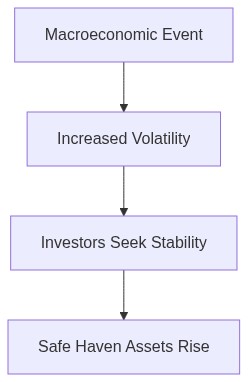
- Gold prices have surged as central banks and institutional investors increase holdings in response to geopolitical tensions and currency instability.
- The global trend of de-dollarization, especially among emerging markets, places gold as a preferred asset to mitigate currency risks.
- Cryptocurrencies, though initially perceived as safe havens, have faced volatility, pushing institutions back towards the traditional stability of gold.
- Recent monetary policy shifts and inflation concerns have further fueled gold’s appeal as a hedge against expected dollar depreciation.
- ETF inflows and increased central bank reserves reflect a strategic move towards gold, anticipating a long-term shift in global currency dynamics.
“Liquidity is a coward; it disappears at the exact moment you need it most.”
The Gold Resurgence: Institutional Safeguard Against Dollar Decline
Liquidity Dynamics and Gold’s Strategic Functionality Amid Dollar Vulnerability
In the perplexing labyrinth of contemporary financial markets, the operational dynamics of liquidity have progressively transformed. Gold has strategically re-emerged as a paramount asset, instrumental in counterbalancing the oscillations of the global currency benchmark: the U.S. Dollar. The liquidity dynamics intrinsic to gold, juxtaposed with its relative stasis during periods of financial solvency stresses, offers an intriguing frictional hedging mechanism against the vicissitudes of dollar-centric assets. Over recent cycles, investors have manifested an elevated awareness of liquidity traps inherent in traditional fiat systems, prompting an observable pivot towards gold. Underlying this move is the realization that during economic contractions and expansions alike, gold does not merely preserve wealth but actively engages in market stabilization as a liquidity reserve.
The actuarial resilience of gold resonates with elite fund managers as a non-cyclical asset class, first because of its intrinsic ‘liquidity premium’. This premium, a fundamental component of asset pricing, is emboldened by low tangibility risk and minimal counterparty exposure – differentiating it distinctly from dollar-denominated securities. Moreover, gold’s adaptability in hedonic adjustment calculations during fiscal uncertainty underscores its flexibility in satisfying contingency requirements without the tail risk associated with precipitous currency depreciation. As reinforced by the Bank for International Settlements, “Gold reserves continue to act as a currency stabilizer when traditional fiat reserves come under speculative pressure” (BIS).
Furthermore, the transactional nature of gold facilitates not only hedging against currency risk but enhances convexity for investors seeking to realign their portfolios towards assets with lower duration risk. In an era augmented by digital financial architectures, the embedding of gold within algorithmic trading frameworks is demonstrative of its non-substitutable liquidity provision characteristic. Essentially, as dollar erosions augment liquidity stress, gold’s role pivots from passive storage to active liquidity – a transformation crucial for institutional entities managing diversified asset-allegiant portfolios.
Portfolio Convexity and the Strategic Leveraging of Gold Futures
Incorporating gold within institutional portfolios has always been a calculated art of harnessing convexity advantages, an art that has gained significant traction amid recent backlashes against dollar hegemony. Gold futures, uniquely positioned at the intersection of speculative intent and hedging imperative, have witnessed an unprecedented uptick, driven by an era of dollar instability underpinned by geopolitical vectors and fiscal deficits. For elite fund managers, the strategic leveraging of gold futures presents a calculated methodology to incubate portfolio convexity, circumventing the innate challenge of sustaining positive carry without incurring undue volatility risk.
The contango configuration, historically a hallmark of gold futures, currently offers an intriguing narrative linked to market anticipation of forward price realignment amidst currency devaluation pressures. Institutions are curating sophisticated deployment strategies, utilizing gold forwards to moderate basis risk and enhance yield capture – a forward-looking strategy grappling with both currency depreciation and monetary policy-induced volatilities. This involves a multifaceted approach to futures allocation, leveraging the juxtaposition between long futures positions and short cash versus contracts to optimize the yield curve amidst changing dollar valuations.
The strategic kernel of deploying gold so assertively lies in its ability to buffer against sharp movements in the dollar index, ensuring that market neutrality is complemented by a managed approach to carry risk. Moreover, as a senior analyst from the Federal Reserve noted, “The recalibration of the dollar poses systemic risk challenges which necessitate augmented hedging tools to mitigate adverse currency fluctuations” (Federal Reserve). In this light, the convexity-plurality of gold futures becomes not merely a passive risk mitigation instrument but an essential derivate play for those dictating substantial equity inflows and outflows in tune with global market volatilities.
Macroprudential Stability and Gold’s Role in Institutional Policy Frameworks
The resurgence of gold as an institutional safeguard in the face of dollar depreciation highlights its nuanced role in macroprudential stability strategies. In the post-pandemic economic architecture, characterized by volatile interest rate environments and disinflationary pressures, gold offers a pragmatic convergence of wealth preservation and regulatory alignment. Institutions, responsible for overseeing the systemic stability of financial markets, are increasingly incorporating gold holdings to counteract imbalances sparked by supply chain disruptions and financial asymmetries exacerbated by the dollar’s decline.
Institutions are gravitating towards gold not only due to its intrinsic value-retaining properties but through its benefits to policy frameworks seeking to buffer system-wide liquidity constraints. For financial institutions navigating the intricacy of Basel III liquidity requirements, gold’s status under both High-Quality Liquid Asset (HQLA) mandates and Tier 1 capital treatment paves the way for sophisticated capital adequacy planning. This structured alignment allows institutions to concurrently achieve macroprudential targets while mitigating ‘crowding out’ effects attributable to excessive fiat reserve allocation under pressure.
Moreover, gold’s stabilizing influence on institutional strategies offers an invaluable hedge against systemic contagion – a premise echoed by a senior policy advisor from the Bank for International Settlements who indicated, “A strategic precious metal reserve acts as a stable countercyclical reserve against systemic instabilities emergent from devaluation paradigms” (BIS). Therefore, the allocation of gold within institutional portfolios is complemented by systemic importance, offering versatility in accommodating non-convergent market shocks while synchronizing with broader macroeconomic policy initiatives spearheaded by central banking entities across the globe.
| Aspect | Retail Approach | Institutional Overlay |
|---|---|---|
| Objective | Maximize short-term gains | Preserve wealth and manage risk against currency fluctuations |
| Investment Horizon | Short to medium term | Long-term focus |
| Risk Management | Limited risk management tools | Advanced hedging strategies |
| Access | Accessible through retail brokers | Direct access to gold markets and derivatives |
| Leverage | Higher leverage options available | Leverage is carefully managed and employed |
| Analytics | Basic market trend analysis | Extensive quantitative models and forecasting |
| Portfolio Diversification | Limited diversification strategies | Broad diversification including multi-asset classes |
| Transaction Costs | Higher due to retail fees | Lower due to institutional rates |
| Market Impact | Minimal market impact | Significant market participation can affect prices |
| Liquidity | Higher liquidity constraints | Access to deeper liquidity pools |
| Information Access | Limited to public domain | Access to proprietary and advanced data |