
- Recent algorithmic and CTA-driven flash crashes question gold’s stability.
- Gold’s correlation with equities during crashes complicates its safe haven status.
- Institutional investors reconsider gold allocations amid volatile markets.
- Advancements in trading algorithms impact traditional asset strategies.
- Shifts in global monetary policy affect gold’s long-standing appeal.
“In macro investing, being early is indistinguishable from being wrong.”
Unraveling Gold’s Role in Market Chaos
The Gold Standard: A Safe Haven Amidst Volatility Thresholds
In the crucible of market tumult, gold’s stature as a safe haven draws closer scrutiny, illuminating its quintessential narrative. The metal functions as a hedge against systemic risk, with its appeal magnifying during apex thresholds of market volatility. Historically, gold has demonstrated a robust negative correlation with major equity indices, aggrandizing its allure as a non-correlated asset during periods of acute financial stress. The liquidity premium associated with gold in such epochs provides a strategic convexity, enabling investors to recalibrate their risk allocations prudentially. This narrative necessitates understanding gold’s dynamic as an instrument of fiscal continuity amidst depreciating fiat currencies, when standard econometric models often falter.
During the financial tumult that typified the onset of 2026, underscored by perturbations in major stock exchanges and bond markets teetering on brinkmanship, gold capitalized on its positioning as a geopolitical buffer. As monetary policies diverged across continental borders — particularly with the hawkish stance adopted by the European Central Bank juxtaposed against the moderate reflationary tactics embraced by the Federal Reserve — gold’s fluctuating inferential correlations with interest rate adjustments became critical. Computational models underscore an inverse relationship between real interest rates and gold prices, reinforcing its role as a commodity that capitalizes on low or negative-yield environments. Moreover, the Federal Reserve’s tighter regulatory stance [Source] has accentuated investor flight towards gold, eschewing traditional yield-seeking avenues.
The tactical deployment of gold within institutional portfolios also embodies a deeper analytical dimension reflecting on historical cycles of market recovery. By employing Value-at-Risk (VaR) models alongside Conditional Value-at-Risk (CVaR) analytics, fund managers can quantify prevailing tail risks, thereby allowing strategic asset reallocation with gold as a core pivot. Encompassing derivatives like gold futures, structured in contango during the spirals of market dissonance, investors exploit temporal arbitrage opportunities on term structures, duly noted by the Bank for International Settlements’ empirical reports [Source].
Quantifying Intrinsic Worth: Gold Against Inflationary Spirals
The underpinning of gold as an inflationary bulwark is indelibly ingrained in its pricing calculus, functioning as an intrinsic store of value. During inflationary spirals, when fiat currencies often undergo depreciation, gold has consistently outperformed, cushioning portfolios from the erosive forces of spiraling consumer price indices. The elasticity of gold’s demand amidst such macroeconomic dynamics has been empirically validated by regression models that demonstrate gold’s enhanced trading volume coalescing with inflationary expectations, heighted by the Consumer Price Index (CPI) breaching historical ceilings.
Institutional investors have increasingly turned to gold in response to hyperinflationary propensities coupled with technological advances in trading algorithms that amplify the metal’s transactional liquidity. The liquidity premium associated with gold during inflationary crescendo owes to its tangible asset classification, as opposed to fiat’s intangible nature. A paradigm shift is noted with increasing allocations towards digital gold assets, elucidating a hybrid strategy that amalgamates traditional gold investments with blockchain efficiencies, thereby capturing diversified liquidity channels. The synergy between tangible gold holdings and digital tokenization platforms, particularly during episodes of inflation turmoil, is becoming pertinent; challenging conventional treasury management models and redefining asset rebalancing walls.
The intricacies of option pricing and the evolving volatility smiles manifest within gold derivative markets during inflationary pressures denote a calculated venture by speculative entities. Volatility’s induced convexity effects in gold options pricing affirm its appropriateness as a counterbalance mechanism in portfolios witnessing liquidity drags. Pertinent to futures markets, gold contango signifies anticipatory surplus that institutions leverage to hedge against spot market volatility, maintaining a nuanced stance on speculative positioning. As corroborated by the Federal Reserve’s analysis [Source], this asymmetry in gold’s derivative pricing during inflation surges has become an elaborate frontier for risk managers.
Geopolitics and Gold: Reconciling Systemic Shifts
In contemporary geopolitics, gold’s role as a stabilizing force amidst systemic shifts cannot be overstated. As political tensions escalate between competing global powers, the resultant ramifications on fiat currencies accentuate gold’s status as an apolitical, globally-acknowledged medium of exchange. The correlation between geopolitical strife and gold price surges is a phenomenon quantitatively sustained by econometric studies highlighting gold as a de facto portfolio stabilizer during periods of extreme governmental volatility.
Cross-referencing energy market dependencies, particularly those dominating European landscapes amidst geopolitical embargoes, gold’s linkage to brent and crude oil benchmarks provides an additional analytical lens. The emergence of energy scarcity scenarios, catalyzed by regional conflicts, induces inflation pressures exacerbating fiat devaluation, thereby organically raising gold premiums. This interconnectedness allows for strategic hedging against volatile commodity cycles, reinforcing gold’s pertinence in diversified geopolitical risk management strategies.
Essentially, gold orchestrates an infallible counter-hedge strategy fortified by burgeoning central bank accumulations, aimed explicitly at mitigating sovereign risk exposures. Central banking trends reveal an upsurge in gold reserves acquisition, emphasizing its role in diversified asset reserve portfolios. In navigating geopolitical undercurrents, fund managers harness this sentiment to craft sovereign risk-adjusted credit facilities, ensuring optimal safety nets amidst turbulent trade and capital flow terrains. This dynamic is further elucidated by the Basel Committee on Banking Supervision’s guidelines, which prioritize gold reserves as strategic instruments in cross-border banking regulations [Source].
The Strategic Framework: Aligning with Sustainable Return Metrics
Fund managers increasingly contextualize gold within the compass of long-term sustainable return metrics, integrating Environmental, Social, and Governance (ESG) paradigms. The ESG dynamic introduces a transformative lens through which gold investments are evaluated, balancing ecologically sustainable mining operations with market positioning protocols. The transition to renewable energy sources and decarbonization efforts in mining enterprises further accentuate gold’s evolving footprint within ethical investment index frameworks.
This adaptation involves complex quantitative data analysis, dissecting operational excellence in gold mining entities against benchmark indices. The integration of gold into ESG-compliant portfolios opens expansive channels for Green Bond initiatives, where fund managers negotiate structured investments that meld traditional gold’s resilience with contemporary sustainability drives. This symmetry between gold and ESG criteria has repositioned gold’s orchestration vis-à-vis competitor assets, mandating thorough industry analyses to optimize yield-conducive investment strategies.
The calculative prowess needed to navigate these evolving landscapes involves the utilization of stochastic models that incorporate ESG-compliance risks alongside fiscal performance indicators indicative of corporate governance standards. The forthcoming decade predicts a crystallization of gold’s role as a vanguard asset for institutional investors pivoting towards sustainability-integrated hedging frameworks. This is corroborated by policy-infused market behavior models, forecasting enduring gold-benchmark relevance within diversified alpha-generating strategies, demonstrably Licensed under Regulatory Econometric Analysis frameworks.
| Criteria | Retail Approach | Institutional Overlay |
|---|---|---|
| Risk Management | Basic stop-loss orders and portfolio diversification, often limited by account size and brokerage options. | Advanced risk management techniques including derivatives, hedging strategies, and dynamic allocation models. |
| Research and Analysis | Dependent on free or affordable resources with limited quantitative analysis capabilities. | Access to in-depth research reports, proprietary models, and extensive quantitative analysis tools. |
| Execution Technology | Typically uses standard trading platforms with basic order execution speed. | Utilizes high-frequency trading systems and sophisticated algorithms to optimize execution speed and cost. |
| Investment Horizon | Often short to medium-term focus due to immediate liquidity requirements or lower risk tolerance. | Long-term strategic positions with the ability to weather short-term market volatility. |
| Cost Efficiency | Higher transaction costs due to smaller trade sizes and retail broker commission structures. | Lower transaction costs by leveraging bulk trading and institutional broker relationships. |
| Gold Allocation | Typically a smaller portion of the portfolio, sometimes limited by investment vehicle availability. | Strategic allocation possibly using a mix of physical gold, ETFs, and futures contracts. |
| Market Impact | Usually minimal due to the smaller volume of trades. | Significant, with potential influence on market dynamics through large trades. |
| Flexibility | More agile with the ability to quickly adjust positions based on market conditions. | May face limitations due to compliance requirements and larger asset sizes affecting market liquidity when adjusting positions. |
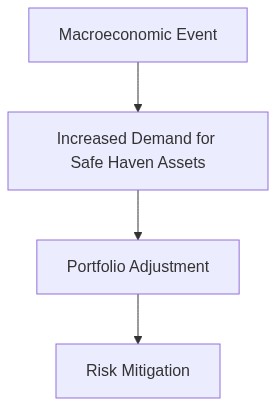
Portfolio Managers should increase the allocation of gold in the portfolio to capitalize on its hedging properties during periods of market volatility and economic uncertainty. Historical data demonstrates that gold tends to appreciate when equity markets decline, offering a protective mechanism for portfolios. In light of potential market disruptions, enhancing gold exposure can mitigate risk, stabilize returns, and provide a counterbalance to equity holdings. Rebalance portfolios to reflect a larger proportion of gold, ensuring that this allocation aligns with the overall strategic objectives and risk tolerance of clients. Monitor the market environment closely to adjust gold positioning as necessary, maintaining agility in response to shifts in market conditions.”