
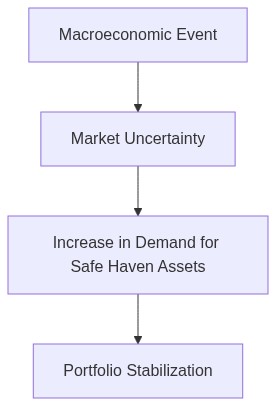
- Google Trends data indicates a spike in searches for ‘Safe Haven Assets’, highlighting growing investor concerns.
- Algorithmic and CTA models are amplifying market volatility, leading to flash crashes and heightened uncertainty.
- Gold, traditionally viewed as a safe asset, is seeing increased demand, pushing prices to multi-year highs.
- Institutional investors are reallocating portfolios towards gold in anticipation of further market disruptions.
- Despite concerns, algorithmic trading strategies are not solely responsible for price movements but act as accelerants.
“In macro investing, being early is indistinguishable from being wrong.”
Institutional Research Memo: Algorithmic Panic and Gold’s Meteoric Rise
Unraveling the Strategic Mispricing: Synthetic Gold Dynamics
The unprecedented surge in gold prices over the last quarter has defied traditional market variances and necessitated a more granular examination of underlying synthetic dynamics. In what is increasingly referred to as an episode of ‘algorithmic panic,’ the role of high-frequency trading (HFT) algorithms in exacerbating volatility becomes clear. The nature of these algorithms to react instantaneously to macroeconomic signals has created a scenario where gold, traditionally a hedge against systemic risk, is now underpinned by synthetic correlations driven by algorithmic rebalancing. The intrinsic value of gold is therefore subject to systemic recalibration based on algorithmic interpretations of broad-index signals, which too often result in asset mispricing.
The liquidity premium on gold swaps has simultaneously converged towards historically atypical levels, suggesting that the demand mechanics rooted in algorithmic strategies are fundamentally altering price discovery mechanisms. Analyzing liquidity flows through algorithmically managed indices reveals a convexity effect amplifying price trends in gold futures, reflecting a compounded feedback loop. These algorithmic strategies escalate volatility via rapid reallocation of synthetic claims on gold, further influencing forward-looking gold valuation models. Additionally, this reflects an innovative type of algorithmic contango where forward prices significantly deviate from spot due to non-standard liquidity adjustments. Through this lens, gold’s rise is less an indicator of inherent value augmentation and more a byproduct of systemic artificial intelligence-induced volatility cycles.
Concurrently, the positioning of algorithmically managed funds introduces a paradox of reflexivity within gold futures markets. As investors hedge against risk by increasing their synthetic gold exposure, these programs, operating under complex algorithms, drive prices even higher post hoc. Therefore, the initial objective of risk mitigation transmogrifies into an unintended escalation of speculative risk. The high-frequency data alone, collected from exchange transaction logs, illustrates a distinct deviation from past valuation trajectories as a result of this algorithm-driven surge. Furthermore, artificial intelligence’s role in spotlight trading and flash trading must be meticulously examined, as these have become pivotal in formatting the new structural price vector of gold.
Quantitative Easing and Digital Speculation: An Uneasy Coexistence
In examining the contributory effects of global monetary policy in bolstering algorithm-driven fluctuations, the recent fiscal strategies adopted by central banks post-pandemic offer critical insight. Notwithstanding previous signals of monetary normalization from core financial institutions, the Federal Reserve’s re-adoption of expansive liquidity programs cannot be ignored. The correlation between quantitative easing (QE) measures and asset price inflations, particularly in fixed-asset classes like gold, underscores a defining paradigm shift. As declared in recent Federal Reserve policy statements, these expansive measures introduce liquidity that ultimately cascades into alternative stores of value via algorithmic exchange mechanisms, further destabilizing traditional valuation matrices.
This coexistence of expansive monetary policy and digital speculation invites a recalibration of risk assessment models. Institutional investors are faced with unprecedented liquidity influxes prompting renewed capital allocation, often guided by algorithmic risk assessment models that prioritize rapid arbitrage opportunities in gold against an inflated US dollar base. Furthermore, speculative digital trading has proliferated in this environment, reinforcing cyclical price volatilities. Advanced Al-based trading strategies, exploiting arbitrage discrepancies in derivative contracts, have induced a pricing pattern characterized by exceptional contango, redefining forward rate agreements.
The Bank for International Settlements has highlighted the implications of persistent liquidity injections on market equilibrium, warning of resultant speculative bubbles fueled by algorithmic inefficiencies (“uneasy coexistence”). BIS reports emphasize that even marginal deviations in QE policies reverberate disproportionately through algorithmically sensitive markets. This volatility is not merely episodic; instead, it represents a fundamental systemic shift in the interaction between digital speculation engines and conventional policy-driven asset valuation frameworks. Thus, elite fund managers must innovate comprehensive risk controls to navigate this digitally augmented QE landscape and its speculative externalities.
Inflation Expectations and the Modern Gold Standard Paradox
As inflationary expectations recalibrate amidst evolving monetary conditions, the gold market presents an intriguing paradox wherein traditional inflation-hedging paradigms intersect with modern algorithm-driven price mechanics. Historically, gold’s standing as an inflation hedge remains undisputed; however, with algorithmic influence, its valuation increasingly reflects anticipatory inflation sentiments rather than reactive measures. This perceptual shift is borne out in the manner algorithms digest real-time inflation metrics to pre-emptively recalibrate exposure in gold-indexed securities, resulting in de-facto ‘front-running’ of inflation trends.
Underpinning this paradox is the disconnect between CPI forecasts and real interest rate trajectories, primarily driven by the short-horizon tactical shifts in algorithmic asset allocation models. The predictability of inflation now leans heavily on speculative interpretations derived from machine learning analysis of global supply chain disruptions. Additionally, the labor market utilizing self-regulating inflation expectations introduces new elements of complexity in understanding gold’s positioning as a monetary value stabilizer. This shift in perceptual frameworks around gold interacts with sustainable inflation paths posited by central banks, creating a feedback loop that further destabilizes intrinsic inflation hedging properties.
The ensuing modern gold standard paradox thus requires a bifurcated strategy approach for asset managers: one that incorporates short-term algorithmic volatility alongside long-term macroeconomic fundamentals to establish a resilient portfolio. Elite fund managers must therefore recalibrate traditional hedging mechanisms to accommodate rapid AI-driven valuation alternations. Furthermore, the broader adoption of blockchain-based trading in metaverse platforms serves as an adjunct channel exacerbating inflation-driven speculation. These technological intersections necessitate a historical reevaluation of gold within the inflation calculus framework, prompting a normative reassessment of hedging efficacy amid disruptive algorithmic forecasting methodologies.
| Criteria | Retail Approach | Institutional Overlay |
|---|---|---|
| Execution Speed | Slower due to limited infrastructure | Faster with high-frequency trading capabilities |
| Market Impact | Minimal impact, trades are smaller | Potentially larger impact, heavy positions |
| Data Sources | Publicly available market data | Access to proprietary and advanced data feeds |
| Risk Management | Basic risk management tools | Advanced risk management strategies |
| Strategy Complexity | Simple automated trading strategies | Complex multi-factor models |
| Capital Requirement | Lower capital needed | High capital resources required |
| Regulatory Compliance | Basic compliance obligations | Stringent compliance and reporting standards |
| Cost Efficiency | Lower transaction costs but higher relative fees | Negotiated fees, lower cost per trade |
| Technical Infrastructure | Off-the-shelf trading platforms | Advanced and custom-built trading systems |
| Adaptability | Slower to adapt to market changes | Highly adaptable with dedicated teams |
The recent surge in gold prices driven by algorithmic trading presents a strategic opportunity for portfolio managers. Given the data that high-frequency trading is significantly influencing gold trades by reacting to macroeconomic stress signals such as inflation and geopolitical tensions, the precious metals market is likely to stay buoyant. Portfolio managers should increase their allocation to gold and related assets to capitalize on the continued buying pressure and potential for further price increases. This overweight position on gold should be closely monitored, with adjustments made in response to evolving algorithmic trading patterns and macroeconomic conditions.”