
- A sharp decline in demand for office spaces and retail due to remote working trends and e-commerce growth has led to underperformance in commercial real estate assets.
- Algorithmic trading strategies and increasing reliance on CTAs have resulted in heightened market volatility and increased susceptibility to flash crashes.
- High leverage levels in commercial REITs amplify the impact of market volatility, posing significant financial stability risks.
- Potential regulatory interventions could mitigate risks but may also disrupt market dynamics, leading to unintended consequences for investors.
- Investors are urged to reassess their exposure to commercial REITs and consider risk mitigation strategies.
“The market is a mechanism for transferring wealth from the impatient to the prepared.”
The Erosion of Asset Quality: A Structural Imbalance
The underlying asset quality of Commercial Real Estate Investment Trusts (REITs) is facing a significant decline due to structural imbalances that have developed over the past few years. This erosion can be attributed to several intertwined factors, most notably the seismic shifts in work and consumer behavior patterns amid a post-pandemic economy. The massive exit from office spaces and the decline in traditional retail footfall have dramatically altered the landscape for commercial spaces, yet the reevaluation of asset portfolios has lagged behind these changes. As cap rates have been temporarily buoyed by the liquidity-driven demand spurred by central bank measures, the risk profiles of these assets have quietly deteriorated, introducing a latent instability within commercial REIT portfolios.
A detailed analysis reveals that the current yields on commercial properties no longer reflect inherent risks, a phenomenon reminiscent of reward-risk profiles prior to significant economic corrections. Duration risk has shifted noticeably as properties with long-term leases face increasing tenant default risk or require renegotiated terms in a backdrop where telecommuting and e-commerce have reduced their value propositions. Compounding these dynamics is the convexity effect seen where the value of these properties has become hypersensitive to interest rate shifts, a potential blind spot for fund managers overly reliant on historical performance metrics. According to the Bank for International Settlements, “The low interest rate environment contributed to stretched valuations for certain assets, heightening potential vulnerabilities” (BIS Report).
This fragile balance is further compounded by demographic shifts and evolving environmental, social, and governance (ESG) expectations. As younger generations prioritize sustainable business practices, they eschew traditional shopping and office precincts for more modern, flexible, and environmentally conscious alternatives. Consequently, commercial REITs face the bifurcated challenge of retrofitting existing stock to meet these expectations while simultaneously hedging against the devaluation of underperforming assets within their portfolios. This necessitates a strategic reevaluation of capital allocation strategies, where liquidity premiums must be critically assessed amid this prevailing paradigm shift.
Liquidity Constraints: The Disguised Volatility
Liquidity, or rather the growing paucity of it, has emerged as a critical weakness in commercial REITs, posing significant challenges to fund managers focused on preserving alpha. As interest rates recalibrate to more normalized levels, the once abundant flow of capital into commercial real estate has shown signs of retracting, thus exacerbating the pressure on liquidity reserves. A key driver here is the observable shift in the term structure of interest rates, flattening yield curves and resulting in a contango situation where future pricing fails to incentivize sustained traditional capital flows into the sector.
The phenomenon of disguised volatility is brought to the fore when liquidity bottlenecks lead to marked price movements without underlying changes in asset fundamentals. This introduces an element of unpredictability, where sudden market corrections can occur due to tightened market conditions rather than purely from economic indicators. In this context, the Federal Reserve’s recent pronouncements underscore the uncertainty: “As the economy grows and rates adjust, the market must be prepared for greater volatility due to liquidity constraints” (Federal Reserve 2026 Journal).
The need to preserve liquidity amidst this changing landscape has prompted some funds to resort to asset divestitures and strategic repositioning. However, the cascade effect of such divestitures could lead to markdowns and increased refinancing costs, putting further downward pressure on net asset values. For elite fund managers, navigating this environment requires a precise understanding of liquidity risks integrated with comprehensive stress testing of portfolio assets under varied macroeconomic scenarios. Critically, the liquidity coverage ratio (LCR) must be reconceived, taking into account the new liquidity dynamics in an era where market constraints redefine traditional assumptions.
Interest Rate Convulsions: A Tectonic Challenge
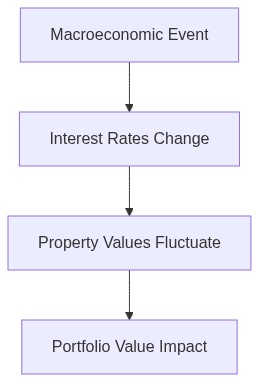
Interest rate convulsions have emerged as one of the most formidable challenges faced by Commercial REITs in recent years. The unpredictability and magnitude of rate hikes implemented by central banks attempting to grapple with inflationary pressures have sent shockwaves through financial markets, particularly affecting sectors heavily reliant on capital costs. For REITs, whose asset valuations and income streams are inextricably tied to interest rate forecasts, the increased convexity seen in today’s economic climate amplifies the sensitivity of asset portfolios to even marginal rate changes.
Fund managers must now contend with recalibrating interest rate hedges as forward guidance offers limited clarity amidst geopolitical uncertainties and supply chain disruptions that continuously recalibrate inflation expectations. The nuanced implication here is an introduced element of spread risk, where fluctuating spreads between borrowing rates and cap rate yields create opportunities for yield spread arbitrage, albeit with heightened risk. As the Bank for International Settlements notes, “Interest rate normalization carries inherent risks, especially on assets with lengthy durations subject to interest rate sensitization.” (BIS Quarterly Review).
The strategic approach to mitigating these challenges involves a comprehensive reassessment of derivative instruments within the portfolio to counteract potential adverse impacts on cash flows. Furthermore, focus on refinancing strategies becomes essential, particularly for managers looking to capitalize on temporary yield advantages despite a volatile interest rate environment. In this context, proactive engagement with market innovations, such as green and sustainability-linked bonds, offers a potential pathway to hedging interest rate exposure while adhering to burgeoning ESG criteria – capturing both immediate-term necessities and aligning with future-forward goals.
Debt Positioned in a High Stakes Game: Strategic Revaluation
As the macroeconomic horizon becomes increasingly fraught with uncertainty, the debt components of Commercial REITs’ balance sheets warrant a strategic reevaluation. The debt markets, rendered more volatile with the flux of interest rates and refinancing costs, have become a high-stakes arena where the cost of capital influences the sustainability and performance of these investments. Elevated leverage ratios previously sustained by low interest rates are now under scrutiny as financial covenants tighten, threatening to trip default clauses across a swath of precarious holdings.
A pivotal concern resides in the maturity profile of REIT debt securities; those with short durations face immediate refinancing hurdles akin to rolling debt amidst a backdrop of increasingly prohibitive rates. This necessitates insulating portfolios with staggered maturity profiles to manage rollover risk effectively. The recent market-wide attention to credit default swap (CDS) spreads as indicators of systemic risk highlights the importance of credit risk management among elite fund managers looking to preemptively navigate turbulent refinancing terrains.
Balancing operational leverage with financial flexibility has become crucial in the competitive repositioning of Commercial REITs. The liquidity crunch, paired with constrained access to attractive refinancing avenues, necessitates a deeper dive into innovative financing solutions, whereby partnerships with private capital or infrastructure funds may provide the needed liquidity influx to shelter REITs from capital market volatility. As elaborated by the Federal Reserve, “Modern financial strategies require an alignment of fiscal prudence and tactical adaptability to navigate current debt landscapes” (Federal Reserve Publication).
| Criteria | Retail Approach | Institutional Overlay |
|---|---|---|
| Investment Horizon | Short to Mid-term | Long-term |
| Risk Appetite | Higher Risk Tolerance | Risk Mitigated |
| Portfolio Diversification | Less Diversified | Highly Diversified |
| Access to Capital | Limited Access | High Access |
| Tactical Flexibility | High Flexibility | Structured Approach |
| Decision-making Process | Individual Driven | Committee-based |
| Market Research | Informal Research | In-depth Analysis |
| Regulatory Compliance | Basic Compliance | Strict Adherence |
| Performance Metrics | Basic Metrics | Advanced Metrics |
| Cost Efficiency | Moderate | Cost-Effective Strategies |
Portfolio Managers should consider reducing exposure to the commercial REIT sector. The data indicates ongoing stress, particularly in the office space segment where occupancy rates are at multi-year lows with no clear signs of recovery. Rent stagnation against high inflation erodes real income and presents further risks to profitability. Given these unfavorable conditions, it would be prudent to allocate resources to more stable or higher-growth sectors. Consider diversifying into sectors such as residential real estate or industries showing resilience to current economic pressures. Stay informed on market trends and be prepared to adjust the strategy if indicators begin to improve.”